the initial substitution of x = a yields the form 0/0. simplify the function algebraically, or use a table…
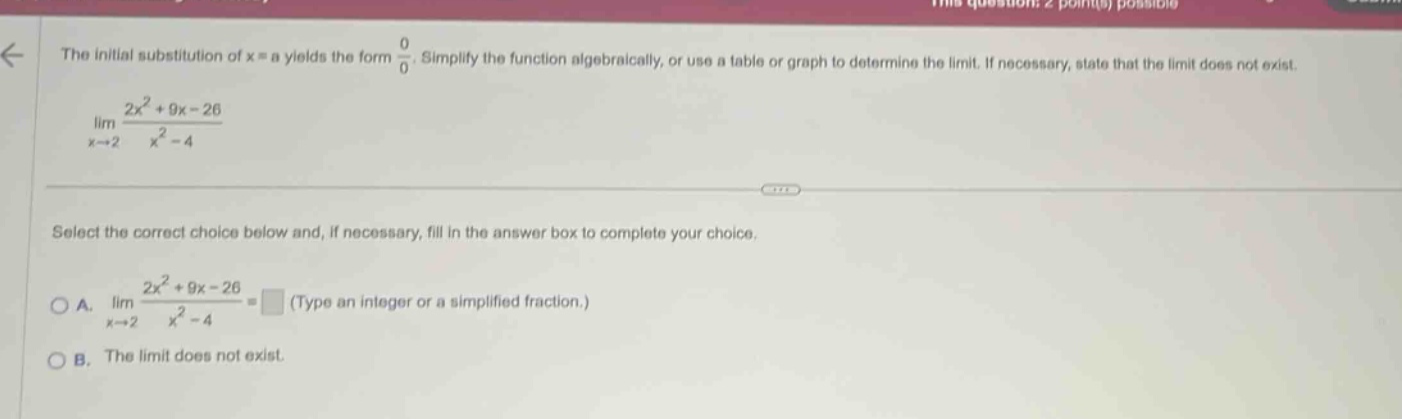
the initial substitution of x = a yields the form 0/0. simplify the function algebraically, or use a table or graph to determine the limit. if necessary, state that the limit does not exist. lim(x→2) (2x² + 9x - 26)/(x² - 4) select the correct choice below and, if necessary, fill in the answer box to complete your choice. a. lim(x→2) (2x² + 9x - 26)/(x² - 4) = (type an integer or a simplified fraction.) b. the limit does not exist.
Answer
Explanation:
Step1: Factor the numerator and denominator
The numerator (2x^{2}+9x - 26=2x^{2}+13x-4x - 26=x(2x + 13)-2(2x + 13)=(2x + 13)(x - 2)). The denominator (x^{2}-4=(x + 2)(x - 2)) using the difference - of - squares formula (a^{2}-b^{2}=(a + b)(a - b)) where (a=x) and (b = 2). So the function becomes (\frac{(2x + 13)(x - 2)}{(x + 2)(x - 2)}).
Step2: Simplify the function
Cancel out the common factor ((x - 2)) (since (x\neq2) when taking the limit), we get (\frac{2x+13}{x + 2}).
Step3: Evaluate the limit
Substitute (x = 2) into (\frac{2x+13}{x + 2}), we have (\frac{2\times2+13}{2 + 2}=\frac{4 + 13}{4}=\frac{17}{4}).
Answer:
A. (\frac{17}{4})