(1) input the equation into the local maxima/minima tool to plot the equation. > enter the equation in the…
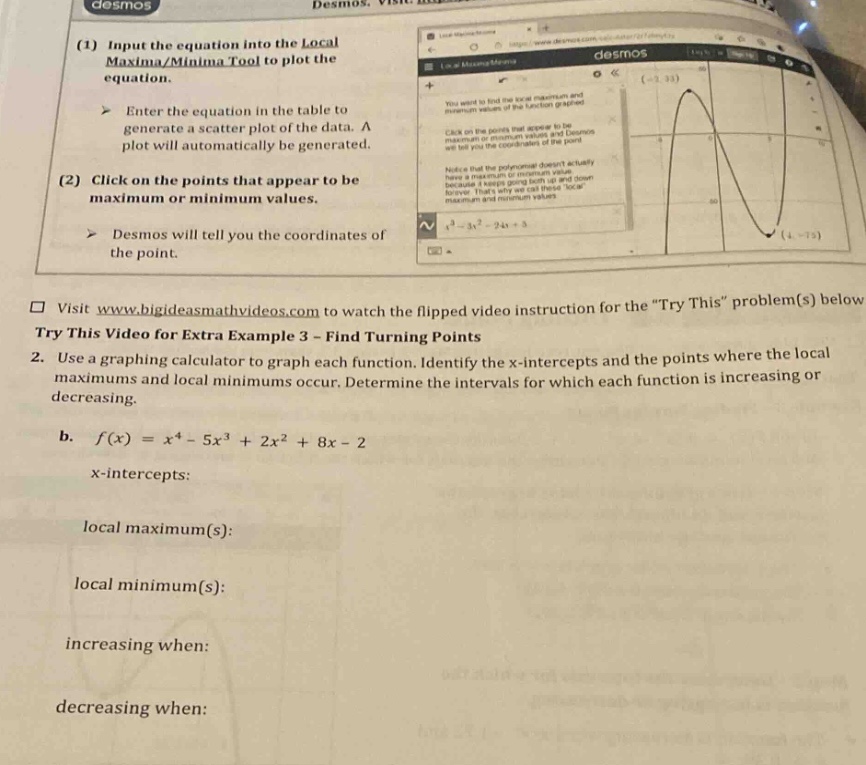
(1) input the equation into the local maxima/minima tool to plot the equation. > enter the equation in the table to generate a scatter - plot of the data. a plot will automatically be generated. (2) click on the points that appear to be maximum or minimum values. > desmos will tell you the coordinates of the point. visit www.bigideasmathvideos.com to watch the flipped video instruction for the \try this\ problem(s) below try this video for extra example 3 - find turning points 2. use a graphing calculator to graph each function. identify the x - intercepts and the points where the local maximums and local minimums occur. determine the intervals for which each function is increasing or decreasing. b. f(x)=x^4 - 5x^3 + 2x^2 + 8x - 2 x - intercepts: local maximum(s): local minimum(s): increasing when: decreasing when:
Answer
Explanation:
Step1: Find the derivative of the function
The derivative of $f(x)=x^{4}-5x^{3}+2x^{2}+8x - 2$ using the power - rule $\frac{d}{dx}(x^{n})=nx^{n - 1}$ is $f^\prime(x)=4x^{3}-15x^{2}+4x + 8$.
Step2: Find the critical points
Set $f^\prime(x) = 0$, i.e., $4x^{3}-15x^{2}+4x + 8 = 0$. We can use numerical methods (such as Newton - Raphson method) or a graphing utility to find the roots. Using a graphing calculator or software, the critical points are approximately $x\approx - 0.57,x\approx1.39,x\approx2.83$.
Step3: Determine the nature of the critical points
We use the second - derivative test. The second - derivative $f^{\prime\prime}(x)=12x^{2}-30x + 4$. Evaluate $f^{\prime\prime}(x)$ at the critical points:
- $f^{\prime\prime}(-0.57)=12(-0.57)^{2}-30(-0.57)+4=12\times0.3249 + 17.1+4\approx25.0988>0$, so $x=-0.57$ is a local minimum.
- $f^{\prime\prime}(1.39)=12(1.39)^{2}-30(1.39)+4=12\times1.9321-41.7 + 4=23.1852-41.7 + 4=-14.5148<0$, so $x = 1.39$ is a local maximum.
- $f^{\prime\prime}(2.83)=12(2.83)^{2}-30(2.83)+4=12\times8.0089-84.9+4=96.1068-84.9+4=15.2068>0$, so $x = 2.83$ is a local minimum.
Step4: Find the x - intercepts
Set $f(x)=0$, i.e., $x^{4}-5x^{3}+2x^{2}+8x - 2 = 0$. Using a graphing utility, the x - intercepts are approximately $x\approx - 0.67,x\approx0.27,x\approx1.64,x\approx3.76$.
Step5: Determine the intervals of increase and decrease
We test the intervals determined by the critical points.
- Choose test points in the intervals $(-\infty,-0.57)$, $(-0.57,1.39)$, $(1.39,2.83)$ and $(2.83,\infty)$.
- For $x=-1$ in $(-\infty,-0.57)$, $f^\prime(-1)=4(-1)^{3}-15(-1)^{2}+4(-1)+8=-4 - 15-4 + 8=-15<0$, so the function is decreasing on $(-\infty,-0.57)$.
- For $x = 0$ in $(-0.57,1.39)$, $f^\prime(0)=8>0$, so the function is increasing on $(-0.57,1.39)$.
- For $x = 2$ in $(1.39,2.83)$, $f^\prime(2)=4(2)^{3}-15(2)^{2}+4(2)+8=32-60 + 8+8=-12<0$, so the function is decreasing on $(1.39,2.83)$.
- For $x = 3$ in $(2.83,\infty)$, $f^\prime(3)=4(3)^{3}-15(3)^{2}+4(3)+8=108-135 + 12+8=138 - 135=3>0$, so the function is increasing on $(2.83,\infty)$.
Answer:
x - intercepts: $x\approx - 0.67,x\approx0.27,x\approx1.64,x\approx3.76$ local maximum(s): $(1.39,f(1.39))\approx(1.39,4.04)$ local minimum(s): $(-0.57,f(-0.57))\approx(-0.57,-5.19)$ and $(2.83,f(2.83))\approx(2.83,-12.87)$ increasing when: $(-0.57,1.39)\cup(2.83,\infty)$ decreasing when: $(-\infty,-0.57)\cup(1.39,2.83)$