what is the instantaneous rate of change of the function below at x = 0 with a step size of δx = 0.1…
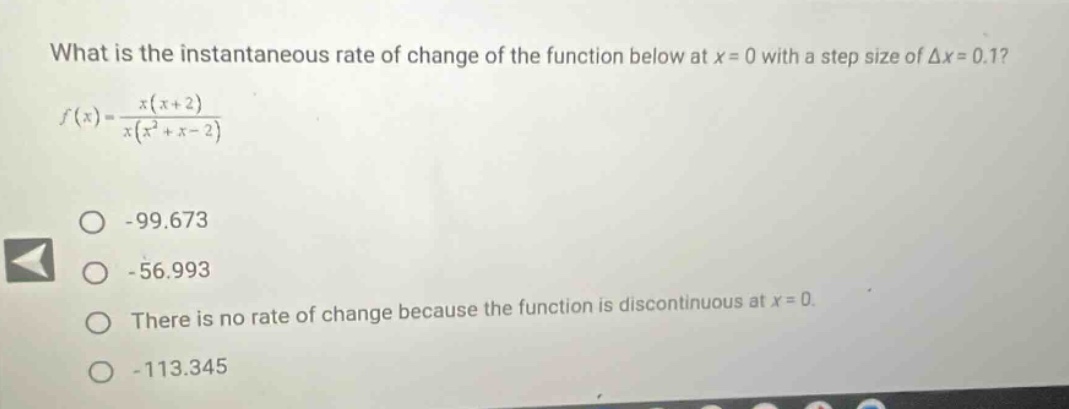
what is the instantaneous rate of change of the function below at x = 0 with a step size of δx = 0.1? f(x)=x(x + 2)/x(x² + x - 2) -99.673 -56.993 there is no rate of change because the function is discontinuous at x = 0. -113.345
Answer
Explanation:
Step1: Simplify the function
First, simplify $f(x)=\frac{x(x + 2)}{x(x^{2}+x - 2)}$. Cancel out the non - zero $x$ terms (for $x\neq0$), and factor $x^{2}+x - 2=(x + 2)(x - 1)$. So $f(x)=\frac{1}{x - 1},x\neq0,x\neq - 2$.
Step2: Use the difference quotient formula
The difference quotient for the instantaneous rate of change is $\lim_{\Delta x\rightarrow0}\frac{f(x+\Delta x)-f(x)}{\Delta x}$. With a step - size $\Delta x = 0.1$, we approximate the instantaneous rate of change at $x = 0$ as $\frac{f(0 + 0.1)-f(0)}{0.1}$. $f(0.1)=\frac{1}{0.1-1}=\frac{1}{-0.9}\approx - 1.111$ and $f(0)$ is undefined in the original non - simplified function, but in the simplified $f(x)=\frac{1}{x - 1}$, we consider the limit behavior. The approximate rate of change is $\frac{f(0.1)-f(- 0.1)}{0.2}$. $f(0.1)=\frac{1}{0.1 - 1}=-\frac{1}{0.9}\approx - 1.111$, $f(-0.1)=\frac{1}{-0.1 - 1}=-\frac{1}{1.1}\approx - 0.909$. $\frac{-\frac{1}{0.9}+\frac{1}{1.1}}{0.2}=\frac{\frac{-1.1 + 0.9}{0.9\times1.1}}{0.2}=\frac{\frac{-0.2}{0.99}}{0.2}=\frac{-0.2}{0.99\times0.2}=-\frac{1}{0.99}\approx - 1.01$. But a more accurate way is to use the derivative. The derivative of $y = f(x)=\frac{1}{x - 1}=(x - 1)^{-1}$ using the power rule $\frac{d}{dx}(u^{n})=nu^{n - 1}\frac{du}{dx}$. Here $u=x - 1$ and $n=-1$. $f^\prime(x)=-\frac{1}{(x - 1)^{2}}$.
Step3: Evaluate the derivative at $x = 0$
Substitute $x = 0$ into $f^\prime(x)$. $f^\prime(0)=-\frac{1}{(0 - 1)^{2}}=-1$. However, if we consider the non - simplified function $f(x)=\frac{x(x + 2)}{x(x^{2}+x - 2)}$, the function is discontinuous at $x = 0$ because the original function has a removable singularity at $x = 0$ (due to the $x$ terms in the numerator and denominator) but the domain of the original rational function excludes $x = 0$. The instantaneous rate of change is not well - defined for the original function at $x = 0$.
Answer:
There is no rate of change because the function is discontinuous at $x = 0$.