1. $int_{1}^{2}(3x^{2}-2x + 1)dx$\n2. $int_{1}^{3}(3x^{2}+\frac{4}{x^{2}})dx$\n3. $int_{0}^{sqrt{7}}xsqrt3{1…
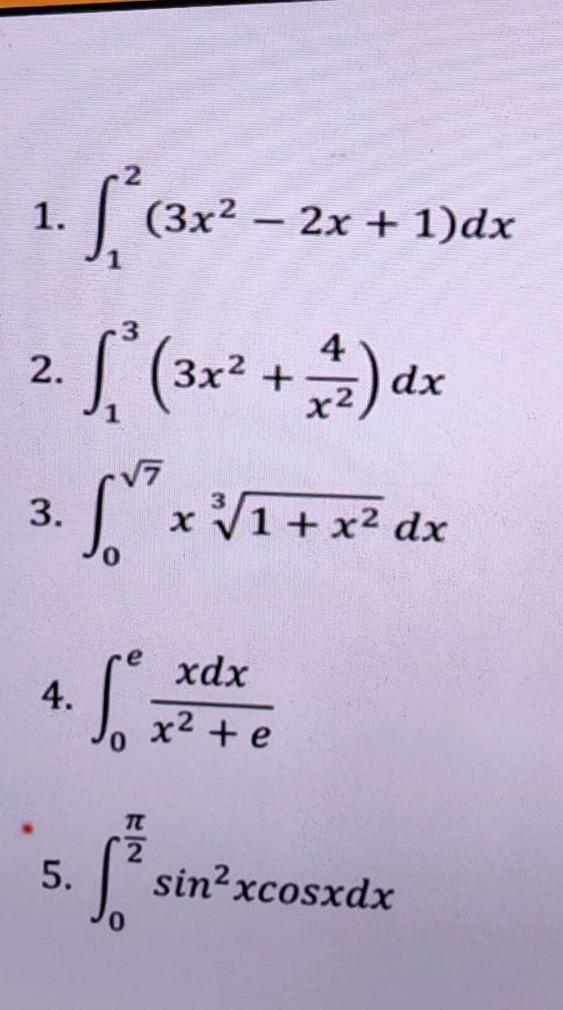
1. $int_{1}^{2}(3x^{2}-2x + 1)dx$\n2. $int_{1}^{3}(3x^{2}+\frac{4}{x^{2}})dx$\n3. $int_{0}^{sqrt{7}}xsqrt3{1 + x^{2}}dx$\n4. $int_{0}^{e}\frac{xdx}{x^{2}+e}$\n5. $int_{0}^{\frac{pi}{2}}sin^{2}xcos xdx$
Answer
1.
Explanation:
Step1: Find antiderivative
The antiderivative of (3x^{2}-2x + 1) is (x^{3}-x^{2}+x) using the power - rule (\int x^{n}dx=\frac{x^{n + 1}}{n+1}+C(n\neq - 1)).
Step2: Apply the fundamental theorem of calculus
(\left[x^{3}-x^{2}+x\right]_1^2=(2^{3}-2^{2}+2)-(1^{3}-1^{2}+1)=(8 - 4+2)-(1 - 1+1)=5 - 1=4)
Answer:
(4)
2.
Explanation:
Step1: Rewrite and find antiderivative
Rewrite (3x^{2}+\frac{4}{x^{2}}) as (3x^{2}+4x^{-2}). The antiderivative is (x^{3}-4x^{-1}) using the power - rule (\int x^{n}dx=\frac{x^{n + 1}}{n + 1}+C(n\neq-1)).
Step2: Apply the fundamental theorem of calculus
(\left[x^{3}-\frac{4}{x}\right]_1^3=(3^{3}-\frac{4}{3})-(1^{3}-\frac{4}{1})=(27-\frac{4}{3})-(1 - 4)=27-\frac{4}{3}+3=30-\frac{4}{3}=\frac{90 - 4}{3}=\frac{86}{3})
Answer:
(\frac{86}{3})
3.
Explanation:
Step1: Use substitution
Let (u = 1+x^{2}), then (du=2xdx) and (x^{2}=u - 1). When (x = 0), (u = 1); when (x=\sqrt{7}), (u=8). The integral (\int_{0}^{\sqrt{7}}x\sqrt[3]{1 + x^{2}}dx=\frac{1}{2}\int_{1}^{8}u^{\frac{1}{3}}du).
Step2: Find antiderivative and evaluate
The antiderivative of (u^{\frac{1}{3}}) is (\frac{3}{4}u^{\frac{4}{3}}). Then (\frac{1}{2}\left[\frac{3}{4}u^{\frac{4}{3}}\right]_1^8=\frac{3}{8}(8^{\frac{4}{3}}-1^{\frac{4}{3}})=\frac{3}{8}(16 - 1)=\frac{45}{8})
Answer:
(\frac{45}{8})
4.
Explanation:
Step1: Use substitution
Let (u=x^{2}+e), then (du = 2xdx). When (x = 0), (u=e); when (x = e), (u=e^{2}+e). The integral (\int_{0}^{e}\frac{xdx}{x^{2}+e}=\frac{1}{2}\int_{e}^{e^{2}+e}\frac{du}{u}).
Step2: Find antiderivative and evaluate
The antiderivative of (\frac{1}{u}) is (\ln|u|). Then (\frac{1}{2}[\ln u]_e^{e^{2}+e}=\frac{1}{2}(\ln(e^{2}+e)-\ln(e))=\frac{1}{2}(\ln(e(e + 1))-1)=\frac{1}{2}(1+\ln(e + 1)-1)=\frac{1}{2}\ln(e + 1))
Answer:
(\frac{1}{2}\ln(e + 1))
5.
Explanation:
Step1: Use substitution
Let (u=\sin x), then (du=\cos xdx). When (x = 0), (u = 0); when (x=\frac{\pi}{2}), (u = 1). The integral (\int_{0}^{\frac{\pi}{2}}\sin^{2}x\cos xdx=\int_{0}^{1}u^{2}du).
Step2: Find antiderivative and evaluate
The antiderivative of (u^{2}) is (\frac{1}{3}u^{3}). Then (\left[\frac{1}{3}u^{3}\right]_0^1=\frac{1}{3}(1^{3}-0^{3})=\frac{1}{3})
Answer:
(\frac{1}{3})