for which interval is the average rate of change of f(x) negative?\no from x = -3.5 to x = -1\no from x = -3…
for which interval is the average rate of change of f(x) negative?\no from x = -3.5 to x = -1\no from x = -3 to x = 3\no from x = 0 to x = 2.5
Answer
Explanation:
Step1: Recall average - rate - of - change formula
The average rate of change of a function $y = f(x)$ over the interval $[a,b]$ is $\frac{f(b)-f(a)}{b - a}$. If $f(b)-f(a)<0$ and $b - a>0$ (or $f(b)-f(a)>0$ and $b - a<0$), the average rate of change is negative. In the context of a graph, if the function is decreasing over the interval $[a,b]$, the average rate of change is negative.
Step2: Analyze each option
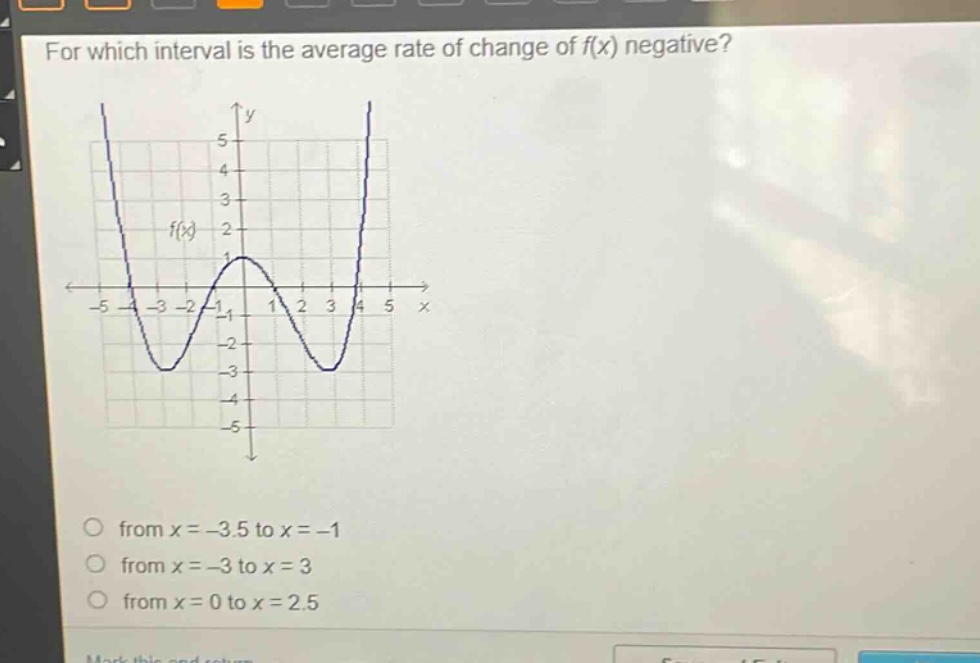
- Option 1: From $x=-3.5$ to $x = - 1$, the function $f(x)$ is increasing. So, the average rate of change $\frac{f(-1)-f(-3.5)}{-1-(-3.5)}>0$.
- Option 2: From $x=-3$ to $x = 3$, the function first increases from $x=-3$ to some point near $x = 0$ and then decreases from that point to $x = 3$. Overall, we need to check $\frac{f(3)-f(-3)}{3-(-3)}$. By observing the graph, $f(3)>f(-3)$, so the average rate of change is positive.
- Option 3: From $x = 0$ to $x=2.5$, the function $f(x)$ is decreasing. So, $f(2.5)-f(0)<0$ and $2.5 - 0>0$, and the average rate of change $\frac{f(2.5)-f(0)}{2.5 - 0}<0$.
Answer:
from $x = 0$ to $x=2.5$