for which interval is the average rate of change of f(x) negative?\no from x = - 3.5 to x = - 1\no from x =…
for which interval is the average rate of change of f(x) negative?\no from x = - 3.5 to x = - 1\no from x = - 3 to x = 3\no from x = 0 to x = 2.5
Answer
Explanation:
Step1: Recall average - rate - of - change formula
The average rate of change of a function $y = f(x)$ over the interval $[a,b]$ is $\frac{f(b)-f(a)}{b - a}$. If $f(b)-f(a)<0$ and $b - a>0$ (since $b>a$ for an interval $[a,b]$), the average rate of change is negative, which means $f(b)<f(a)$. In other words, the function value at the end - point of the interval is less than the function value at the start - point of the interval.
Step2: Analyze the first option
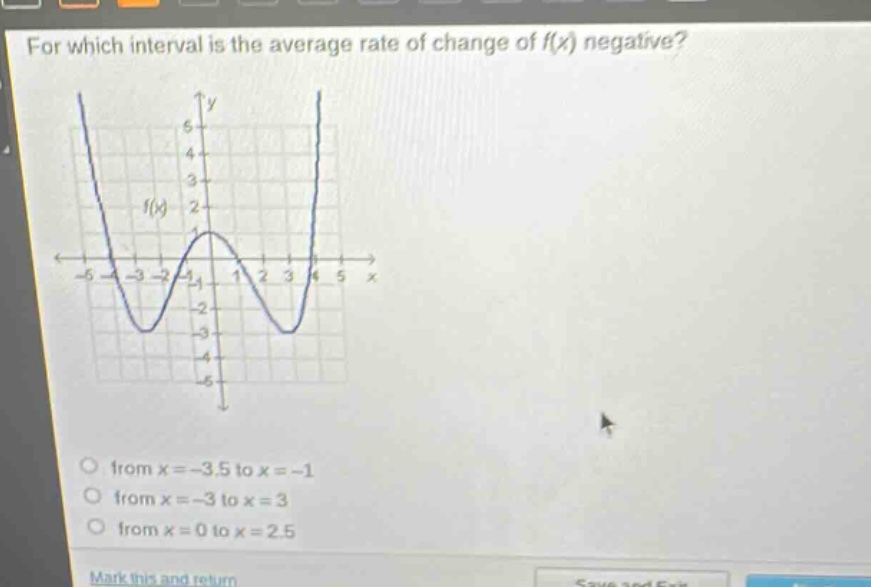
For the interval from $x=-3.5$ to $x = - 1$: Looking at the graph, when $x=-3.5$, $f(-3.5)\approx - 3$ and when $x=-1$, $f(-1)\approx1$. Then $f(-1)-f(-3.5)=1-(-3)=4>0$. So the average rate of change is positive.
Step3: Analyze the second option
For the interval from $x=-3$ to $x = 3$: When $x=-3$, $f(-3)\approx - 2$ and when $x = 3$, $f(3)\approx - 2$. Then $f(3)-f(-3)=-2-(-2)=0$. So the average rate of change is zero.
Step4: Analyze the third option
For the interval from $x = 0$ to $x=2.5$: When $x = 0$, $f(0)\approx1$ and when $x=2.5$, $f(2.5)\approx - 2$. Then $f(2.5)-f(0)=-2 - 1=-3<0$. Since $2.5-0 = 2.5>0$, the average rate of change $\frac{f(2.5)-f(0)}{2.5 - 0}<0$.
Answer:
from $x = 0$ to $x=2.5$