for which interval is the average rate of change of $f(x)$ negative?\nfrom $x = -3.5$ to $x = -1$\nfrom $x =…
for which interval is the average rate of change of $f(x)$ negative?\nfrom $x = -3.5$ to $x = -1$\nfrom $x = -3$ to $x = 3$\nfrom $x = 0$ to $x = 2.5$
Answer
Explanation:
Step1: Recall average rate of change formula
The average rate of change of $f(x)$ on $[a,b]$ is $\frac{f(b)-f(a)}{b-a}$. It is negative when $f(b)-f(a)$ and $b-a$ have opposite signs.
Step2: Analyze Option 1: $x=-3.5$ to $x=-1$
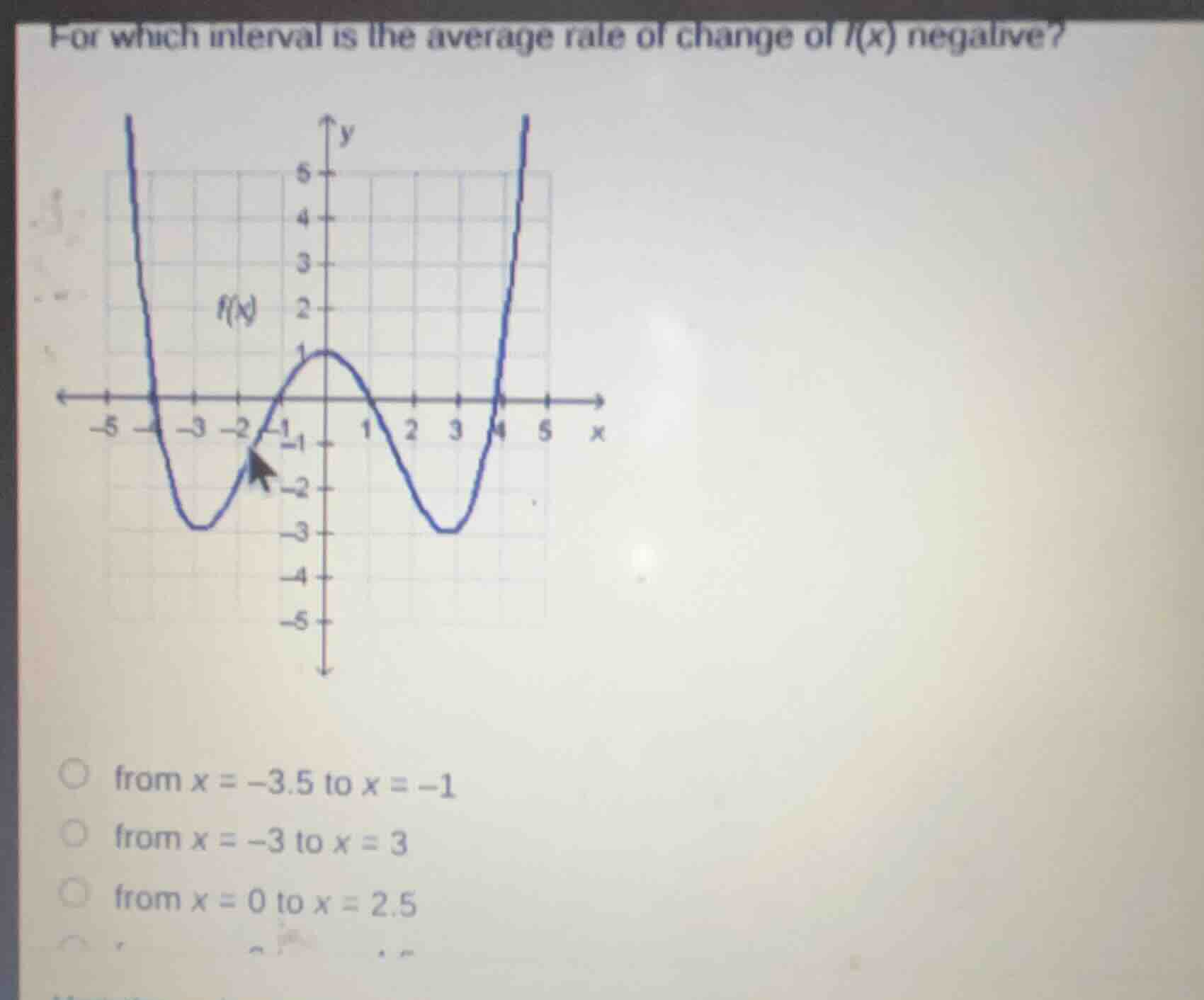
$b-a = -1 - (-3.5) = 2.5 > 0$. From the graph, $f(-3.5)$ is low (negative), $f(-1)=0$, so $f(-1)-f(-3.5) > 0$. Rate is positive.
Step3: Analyze Option 2: $x=-3$ to $x=3$
$b-a = 3 - (-3) = 6 > 0$. $f(-3)$ is negative, $f(3)$ is negative, and $f(3) \approx f(-3)$, so $f(3)-f(-3) \approx 0$. Rate is near 0.
Step4: Analyze Option 3: $x=0$ to $x=2.5$
$b-a = 2.5 - 0 = 2.5 > 0$. $f(0)=1$, $f(2.5)$ is negative, so $f(2.5)-f(0) < 0$. Rate is negative.
Answer:
from $x = 0$ to $x = 2.5$