over which interval does the exponential show a more rapid rate of change?\n0 < x < 1\n0 < x < 2\n1 < x < 2
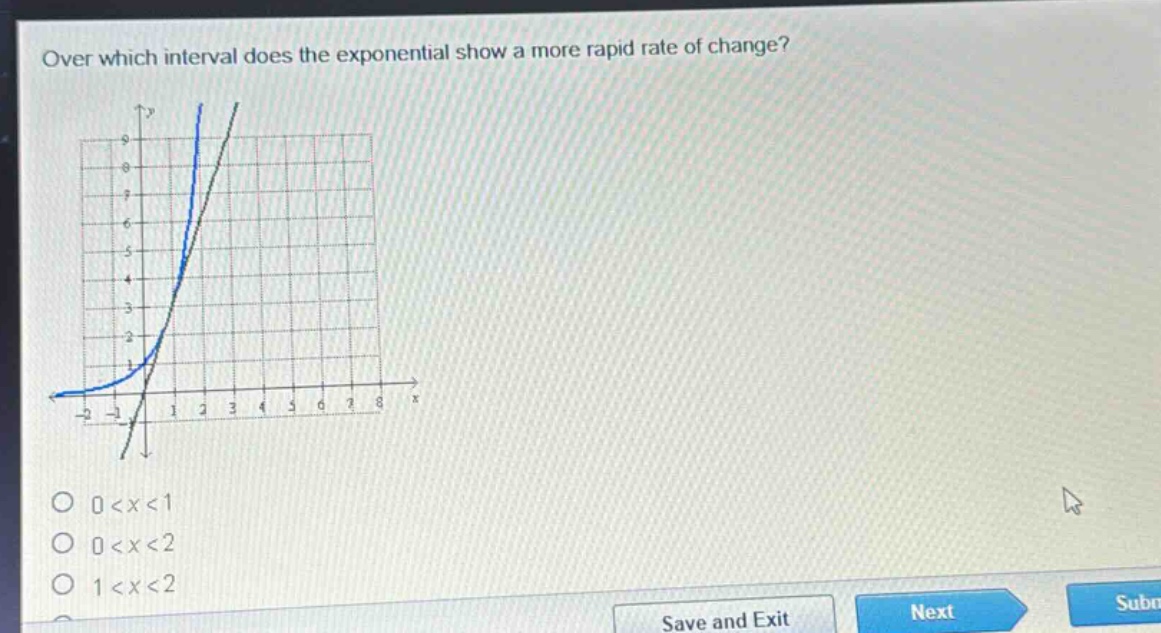
over which interval does the exponential show a more rapid rate of change?\n0 < x < 1\n0 < x < 2\n1 < x < 2
Answer
Explanation:
Step1: Identify the functions from the graph.
The blue curve represents an exponential function, $f(x)$. From the points $(0,1)$, $(1,3)$, and $(2,9)$, we can determine that $f(x) = 3^x$. The black line represents a linear function, $g(x)$. From the points $(0,-1)$ and $(1,3)$, the slope is $m = \frac{3 - (-1)}{1 - 0} = 4$. The y-intercept is -1. So, $g(x) = 4x - 1$.
Step2: Define "more rapid rate of change" over an interval.
A "more rapid rate of change" over an interval means that the average rate of change of the exponential function is greater than the average rate of change of the linear function over that interval. The average rate of change of a function $h(x)$ over $[x_1, x_2]$ is $\frac{h(x_2) - h(x_1)}{x_2 - x_1}$. The average rate of change of the linear function $g(x) = 4x - 1$ is its slope, which is 4.
Step3: Calculate the average rate of change for $f(x)=3^x$ in each interval.
We compare the average rate of change of $f(x)$ ($AROC_f$) with the rate of change of $g(x)$ (which is 4).
For the interval $0 < x < 1$ (i.e., $x_1=0, x_2=1$): $AROC_f = \frac{f(1) - f(0)}{1 - 0} = \frac{3^1 - 3^0}{1} = \frac{3 - 1}{1} = 2$. Since $2 < 4$, the exponential function does not have a more rapid rate of change.
For the interval $0 < x < 2$ (i.e., $x_1=0, x_2=2$): $AROC_f = \frac{f(2) - f(0)}{2 - 0} = \frac{3^2 - 3^0}{2} = \frac{9 - 1}{2} = \frac{8}{2} = 4$. Since $4 = 4$, the exponential function does not have a more rapid rate of change (it's equal).
For the interval $1 < x < 2$ (i.e., $x_1=1, x_2=2$): $AROC_f = \frac{f(2) - f(1)}{2 - 1} = \frac{3^2 - 3^1}{1} = \frac{9 - 3}{1} = 6$. Since $6 > 4$, the exponential function has a more rapid rate of change in this interval.
Answer:
C. $1 < x < 2$