over what interval is the function increasing, and over what interval is the function decreasing?\n| x |…
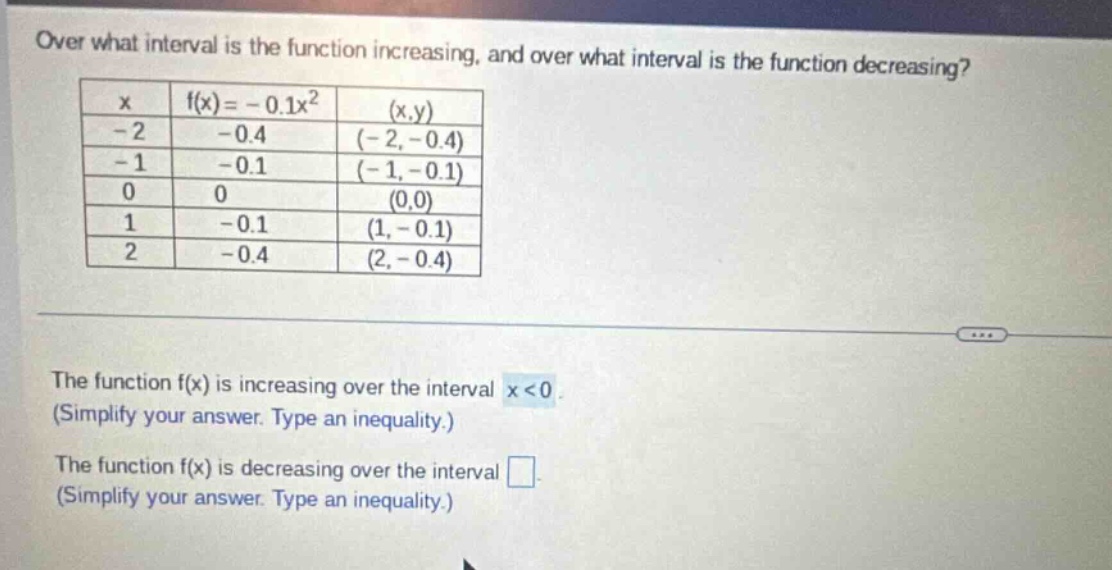
over what interval is the function increasing, and over what interval is the function decreasing?\n| x | f(x)= - 0.1x² | (x,y) |\n| - 2 | - 0.4 | (-2, - 0.4) |\n| - 1 | - 0.1 | (-1, - 0.1) |\n| 0 | 0 | (0,0) |\n| 1 | - 0.1 | (1, - 0.1) |\n| 2 | - 0.4 | (2, - 0.4) |\nthe function f(x) is increasing over the interval x < 0\n(simplify your answer. type an inequality.)\nthe function f(x) is decreasing over the interval \n(simplify your answer. type an inequality.)
Answer
Explanation:
Step1: Analyze the quadratic - function form
The function $f(x)=-0.1x^{2}$ is a quadratic function in the form $y = ax^{2}+bx + c$ where $a=-0.1$, $b = 0$, and $c = 0$. The graph of a quadratic function $y = ax^{2}+bx + c$ is a parabola, and its axis of symmetry is given by the formula $x=-\frac{b}{2a}$. For $f(x)=-0.1x^{2}$, the axis of symmetry is $x = 0$.
Step2: Determine the increasing and decreasing intervals
Since $a=-0.1<0$, the parabola opens down - ward. A parabola that opens downward is increasing to the left of the axis of symmetry and decreasing to the right of the axis of symmetry.
Answer:
$x>0$