on which interval do the functions $f(x)=x^{2}+3x - 5$ and $g(x)=-5$ have the same average rate of…
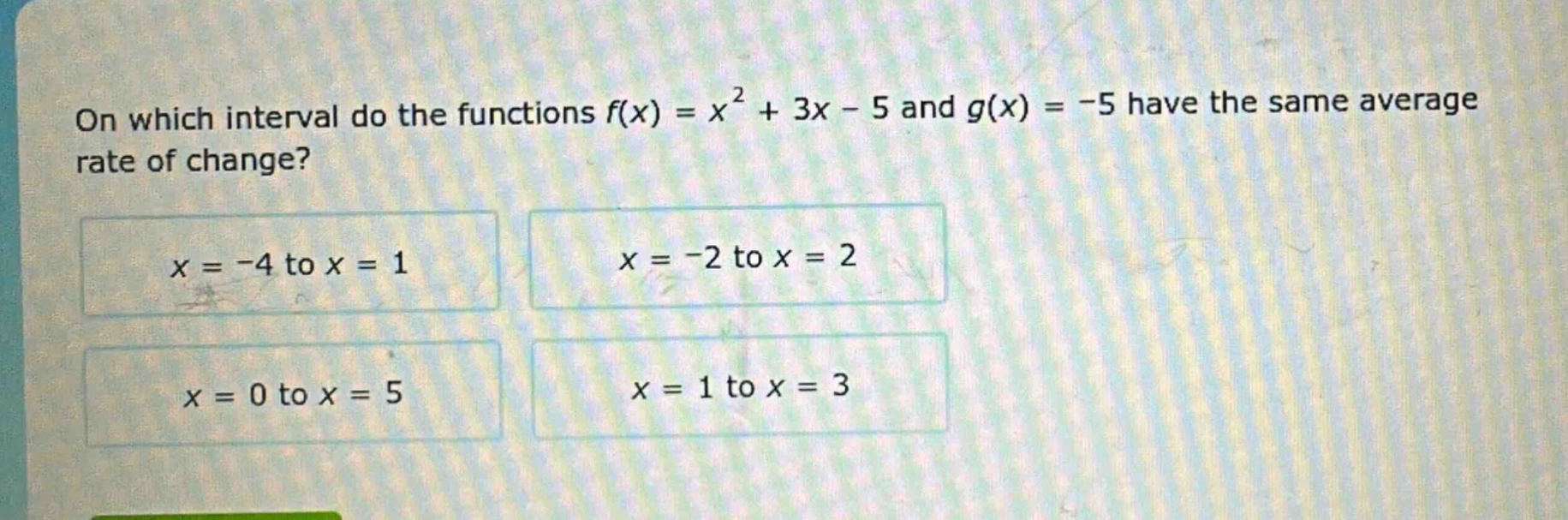
on which interval do the functions $f(x)=x^{2}+3x - 5$ and $g(x)=-5$ have the same average rate of change?\n$x=-4$ to $x = 1$\n$x=-2$ to $x = 2$\n$x=0$ to $x = 5$\n$x=1$ to $x = 3$
Answer
Explanation:
Step1: Recall average - rate - of - change formula
The average rate of change of a function $y = h(x)$ over the interval $[a,b]$ is $\frac{h(b)-h(a)}{b - a}$. For $g(x)=-5$, the average rate of change over any interval $[a,b]$ is $\frac{g(b)-g(a)}{b - a}=\frac{- 5-(-5)}{b - a}=0$. For $f(x)=x^{2}+3x - 5$, the average rate of change over the interval $[a,b]$ is $\frac{f(b)-f(a)}{b - a}=\frac{(b^{2}+3b - 5)-(a^{2}+3a - 5)}{b - a}=\frac{b^{2}-a^{2}+3(b - a)}{b - a}=\frac{(b - a)(b + a)+3(b - a)}{b - a}=b + a+3$.
Step2: Set the average rate of change of $f(x)$ equal to that of $g(x)$
We want $b + a+3 = 0$, or $b=-a - 3$.
Step3: Check each interval
For the interval $x=-4$ to $x = 1$:
$a=-4$ and $b = 1$, then $b+a+3=1+( - 4)+3=0$.
For the interval $x=-2$ to $x = 2$:
$a=-2$ and $b = 2$, then $b + a+3=2+( - 2)+3=3\neq0$.
For the interval $x = 0$ to $x = 5$:
$a = 0$ and $b = 5$, then $b + a+3=5+0+3=8\neq0$.
For the interval $x = 1$ to $x = 3$:
$a = 1$ and $b = 3$, then $b + a+3=3+1+3=7\neq0$.
Answer:
$x=-4$ to $x = 1$