for which interval is f(x) increasing faster than g(x)? 0 ≤ x ≤ 1 -2 ≤ x ≤ -1 -3 ≤ x ≤ -2 2 ≤ x ≤ 3
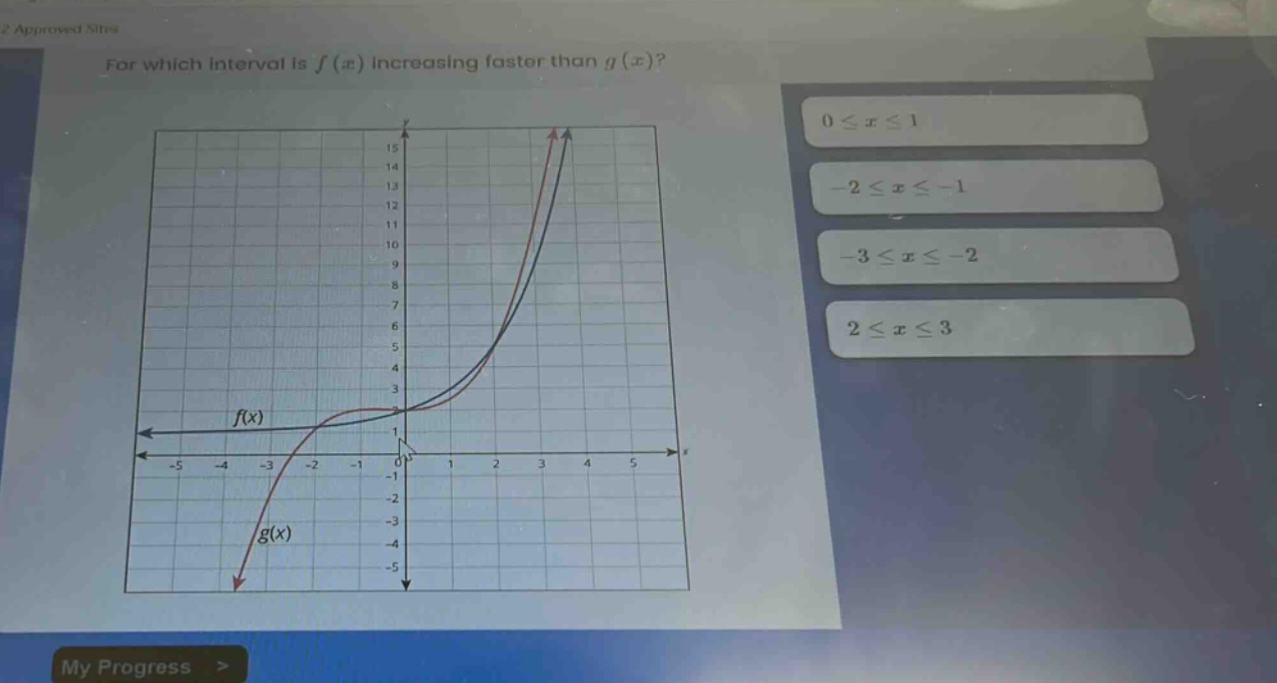
for which interval is f(x) increasing faster than g(x)? 0 ≤ x ≤ 1 -2 ≤ x ≤ -1 -3 ≤ x ≤ -2 2 ≤ x ≤ 3
Answer
Explanation:
Step1: Recall rate - of - change concept
The rate of change of a function is given by its slope. We need to compare the slopes of (f(x)) and (g(x)) on each interval.
Step2: Analyze the interval (0\leq x\leq1)
On the interval (0\leq x\leq1), the slope of (f(x)) is steeper than the slope of (g(x)). The function (f(x)) is increasing more rapidly than (g(x)) in this interval.
Step3: Analyze the interval (- 2\leq x\leq - 1)
On the interval (-2\leq x\leq - 1), (g(x)) is increasing and (f(x)) is decreasing, so (f(x)) is not increasing faster than (g(x)).
Step4: Analyze the interval (-3\leq x\leq - 2)
On the interval (-3\leq x\leq - 2), (g(x)) is increasing and (f(x)) is decreasing, so (f(x)) is not increasing faster than (g(x)).
Step5: Analyze the interval (2\leq x\leq3)
On the interval (2\leq x\leq3), the slope of (g(x)) is steeper than the slope of (f(x)), so (f(x)) is not increasing faster than (g(x)).
Answer:
(0\leq x\leq1)