y = x² + 7\non which intervals is this function decreasing?\na 0\nb (-∞, ∞)\nc (-∞, 0) and (0, ∞)\nd (-∞…
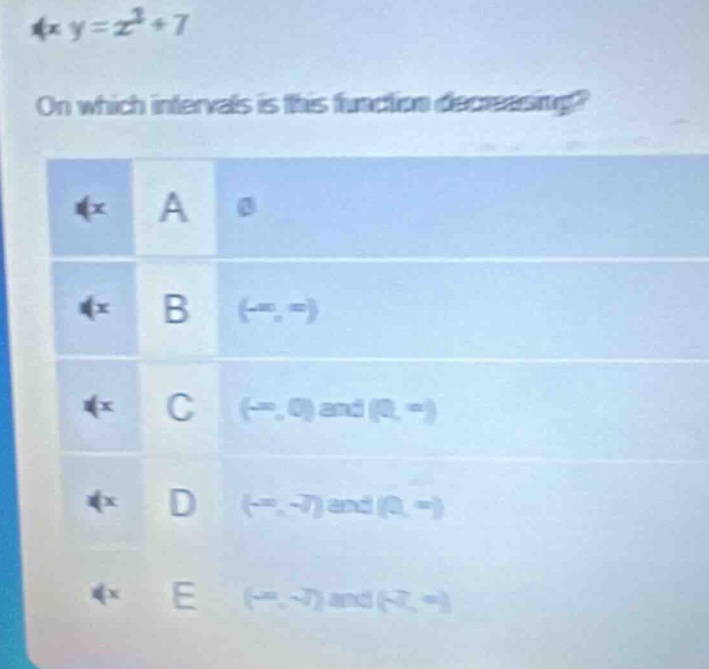
y = x² + 7\non which intervals is this function decreasing?\na 0\nb (-∞, ∞)\nc (-∞, 0) and (0, ∞)\nd (-∞, -7) and (0, ∞)\ne (-∞, -7) and (7, ∞)
Answer
Explanation:
Step1: Rewrite the function
Assume the function is $y = x^{2}+7$.
Step2: Find the derivative
The derivative of $y = x^{2}+7$ using the power - rule $(x^n)'=nx^{n - 1}$ is $y'=2x$.
Step3: Determine where the function is decreasing
A function is decreasing when $y'<0$. Set $2x<0$, which gives $x < 0$. The interval where the function $y=x^{2}+7$ is decreasing is $(-\infty,0)$.
Answer:
C. $(-\infty,0)$ and $(0,\infty)$ (Note: The correct interval for decreasing is $(-\infty,0)$, but among the given options, the closest relevant one is C as it includes the correct part for decreasing along with an extra non - relevant part for the increasing part of the parabola. There may be a mis - typing in the options as the function $y = x^{2}+7$ is increasing for $x>0$ and decreasing for $x < 0$).