on which intervals is this function increasing? a ∅ b (-∞, ∞) c (-∞, -2) and (0, 2) d (-2, 0) and (2, ∞) e…
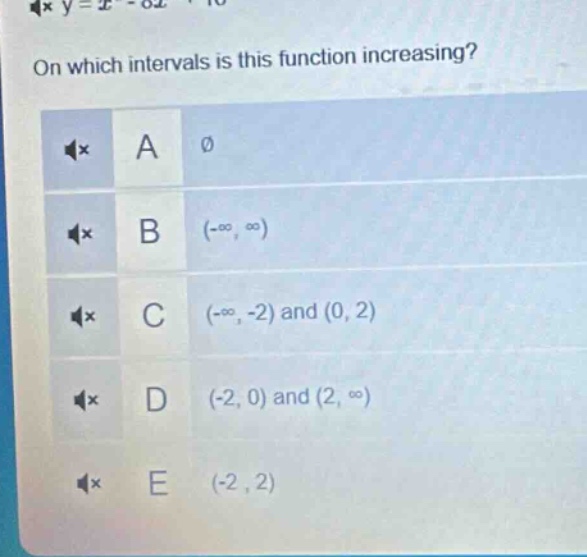
on which intervals is this function increasing? a ∅ b (-∞, ∞) c (-∞, -2) and (0, 2) d (-2, 0) and (2, ∞) e (-2, 2)
Answer
Explanation:
Step1: Find the derivative
Let (y = x^{4}-8x^{2}+10). Using the power - rule ((x^n)^\prime=nx^{n - 1}), we have (y^\prime=4x^{3}-16x = 4x(x^{2}-4)=4x(x - 2)(x + 2)).
Step2: Find the critical points
Set (y^\prime = 0). Then (4x(x - 2)(x + 2)=0). The critical points are (x=-2,x = 0,x = 2).
Step3: Test the intervals
We divide the real - number line into the intervals ((-\infty,-2),(-2,0),(0,2),(2,\infty)). For (x\in(-\infty,-2)), let (x=-3). Then (y^\prime=4\times(-3)\times(-3 - 2)\times(-3 + 2)=4\times(-3)\times(-5)\times(-1)=-60<0). For (x\in(-2,0)), let (x=-1). Then (y^\prime=4\times(-1)\times(-1 - 2)\times(-1 + 2)=4\times(-1)\times(-3)\times1 = 12>0). For (x\in(0,2)), let (x = 1). Then (y^\prime=4\times1\times(1 - 2)\times(1 + 2)=4\times1\times(-1)\times3=-12<0). For (x\in(2,\infty)), let (x = 3). Then (y^\prime=4\times3\times(3 - 2)\times(3 + 2)=4\times3\times1\times5 = 60>0). The function is increasing when (y^\prime>0).
Answer:
D. ((-2,0)) and ((2,\infty))