an inverted conical water tank with a height of 18 ft and a radius of 9 ft is drained through a hole in the…
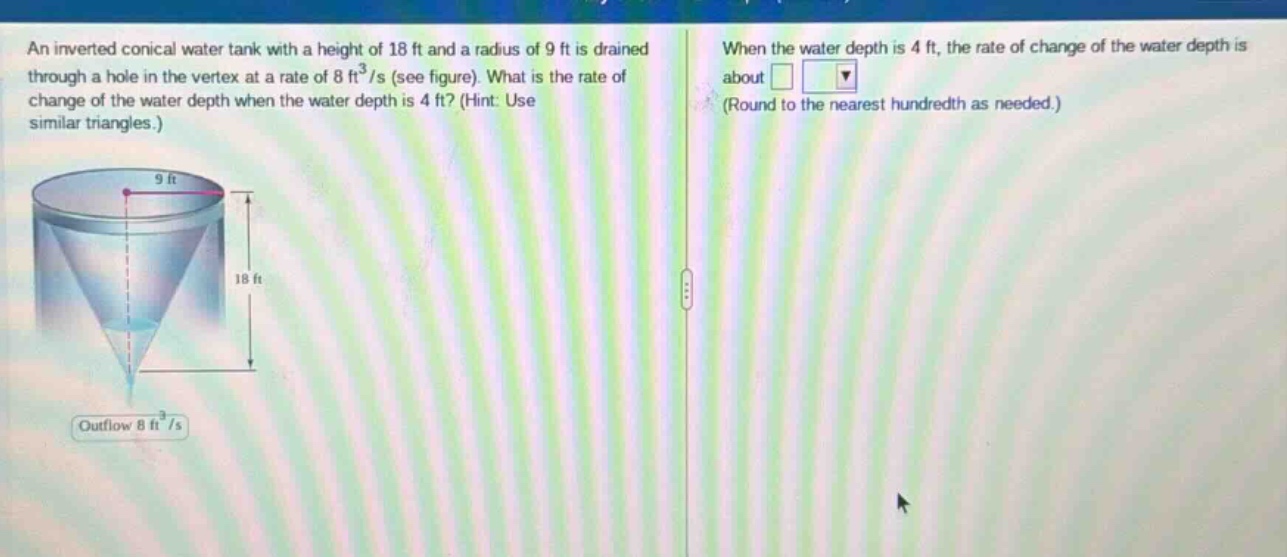
an inverted conical water tank with a height of 18 ft and a radius of 9 ft is drained through a hole in the vertex at a rate of 8 ft³/s (see figure). what is the rate of change of the water depth when the water depth is 4 ft? (hint: use similar triangles.) when the water depth is 4 ft, the rate of change of the water depth is about (round to the nearest hundredth as needed.)
Answer
Explanation:
Step1: Relate radius and height using similar - triangles
For the large cone, the ratio of radius to height is $\frac{r}{h}=\frac{9}{18}=\frac{1}{2}$, so $r = \frac{h}{2}$.
Step2: Find the volume formula of the water in the cone
The volume of a cone is $V=\frac{1}{3}\pi r^{2}h$. Substitute $r = \frac{h}{2}$ into the volume formula, we get $V=\frac{1}{3}\pi(\frac{h}{2})^{2}h=\frac{1}{12}\pi h^{3}$.
Step3: Differentiate the volume formula with respect to time $t$
Using the chain - rule, $\frac{dV}{dt}=\frac{dV}{dh}\cdot\frac{dh}{dt}$. Differentiating $V=\frac{1}{12}\pi h^{3}$ with respect to $h$ gives $\frac{dV}{dh}=\frac{1}{4}\pi h^{2}$. So $\frac{dV}{dt}=\frac{1}{4}\pi h^{2}\frac{dh}{dt}$.
Step4: Solve for $\frac{dh}{dt}$
We know that $\frac{dV}{dt}=- 8$ (negative because the volume is decreasing). When $h = 4$, we substitute into the equation $\frac{dV}{dt}=\frac{1}{4}\pi h^{2}\frac{dh}{dt}$: [ \begin{align*} -8&=\frac{1}{4}\pi(4)^{2}\frac{dh}{dt}\ -8&=4\pi\frac{dh}{dt}\ \frac{dh}{dt}&=-\frac{2}{\pi}\approx - 0.64 \end{align*} ]
Answer:
$-0.64$