julian compared the function (f(x)=4cos(3x)+2) to the linear function (g(x)), which has a slope of 4 and a y…
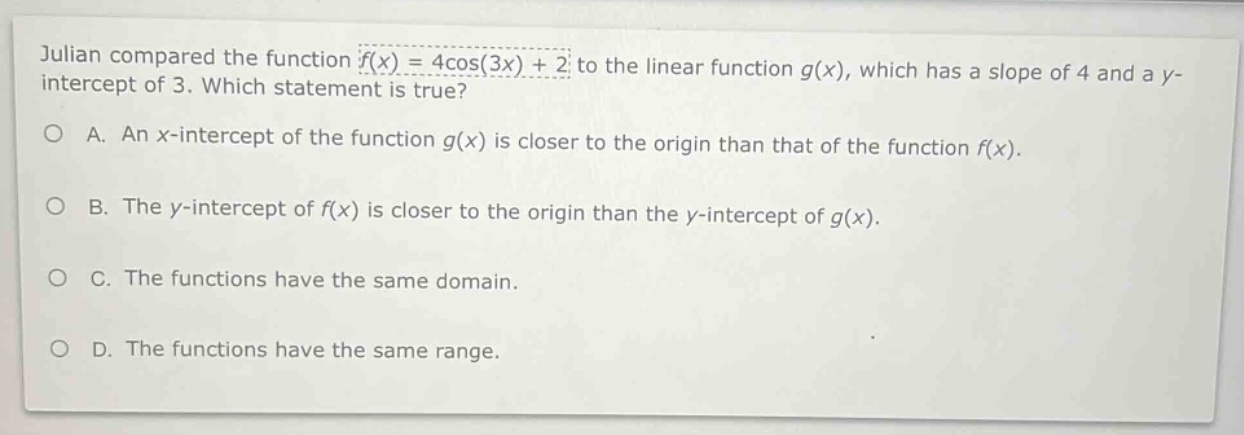
julian compared the function (f(x)=4cos(3x)+2) to the linear function (g(x)), which has a slope of 4 and a y - intercept of 3. which statement is true?\na. an x - intercept of the function (g(x)) is closer to the origin than that of the function (f(x)).\nb. the y - intercept of (f(x)) is closer to the origin than the y - intercept of (g(x)).\nc. the functions have the same domain.\nd. the functions have the same range.
Answer
Explanation:
Step1: Find the y - intercept of (f(x))
Set (x = 0) in (f(x)=4\cos(3x)+2). Then (f(0)=4\cos(0)+2). Since (\cos(0) = 1), (f(0)=4\times1 + 2=6).
Step2: Find the y - intercept of (g(x))
The equation of a line in slope - intercept form is (y=mx + b), where (m) is the slope and (b) is the y - intercept. Given (m = 4) and (b = 3), the y - intercept of (g(x)) is (3). So the y - intercept of (g(x)) is closer to the origin than that of (f(x)), so option B is false.
Step3: Find the x - intercept of (g(x))
Set (y = 0) in (g(x)=4x + 3). Then (0=4x+3), so (x=-\frac{3}{4}).
Step4: Find the x - intercept of (f(x))
Set (f(x)=0), so (4\cos(3x)+2 = 0). Then (\cos(3x)=-\frac{1}{2}). We know that (3x = 2k\pi\pm\frac{2\pi}{3},k\in\mathbb{Z}), so (x=\frac{2k\pi}{3}\pm\frac{2\pi}{9},k\in\mathbb{Z}). The non - zero (x) values closest to the origin are (x=\pm\frac{2\pi}{9}\approx\pm 0.7). The x - intercept of (g(x)) ((x =-\frac{3}{4}=- 0.75)) is not closer to the origin than some of the x - intercepts of (f(x)), so option A is false.
Step5: Analyze the domain
The domain of (f(x)=4\cos(3x)+2) is all real numbers, (\mathbb{R}), since we can input any real number (x) into the cosine function. The domain of the linear function (g(x)=4x + 3) is also all real numbers, (\mathbb{R}). So the functions have the same domain.
Step6: Analyze the range
The range of (y = \cos(3x)) is ([- 1,1]). So the range of (f(x)=4\cos(3x)+2) is ([4\times(-1)+2,4\times1 + 2]=[-2,6]). The range of the linear function (g(x)=4x + 3) is (\mathbb{R}). So the functions do not have the same range.
Answer:
C. The functions have the same domain.