kelly observes that if f(x)=2^x, then the graphs of 3f(x) and f(x)+2 both have a y - intercept of 3. does…
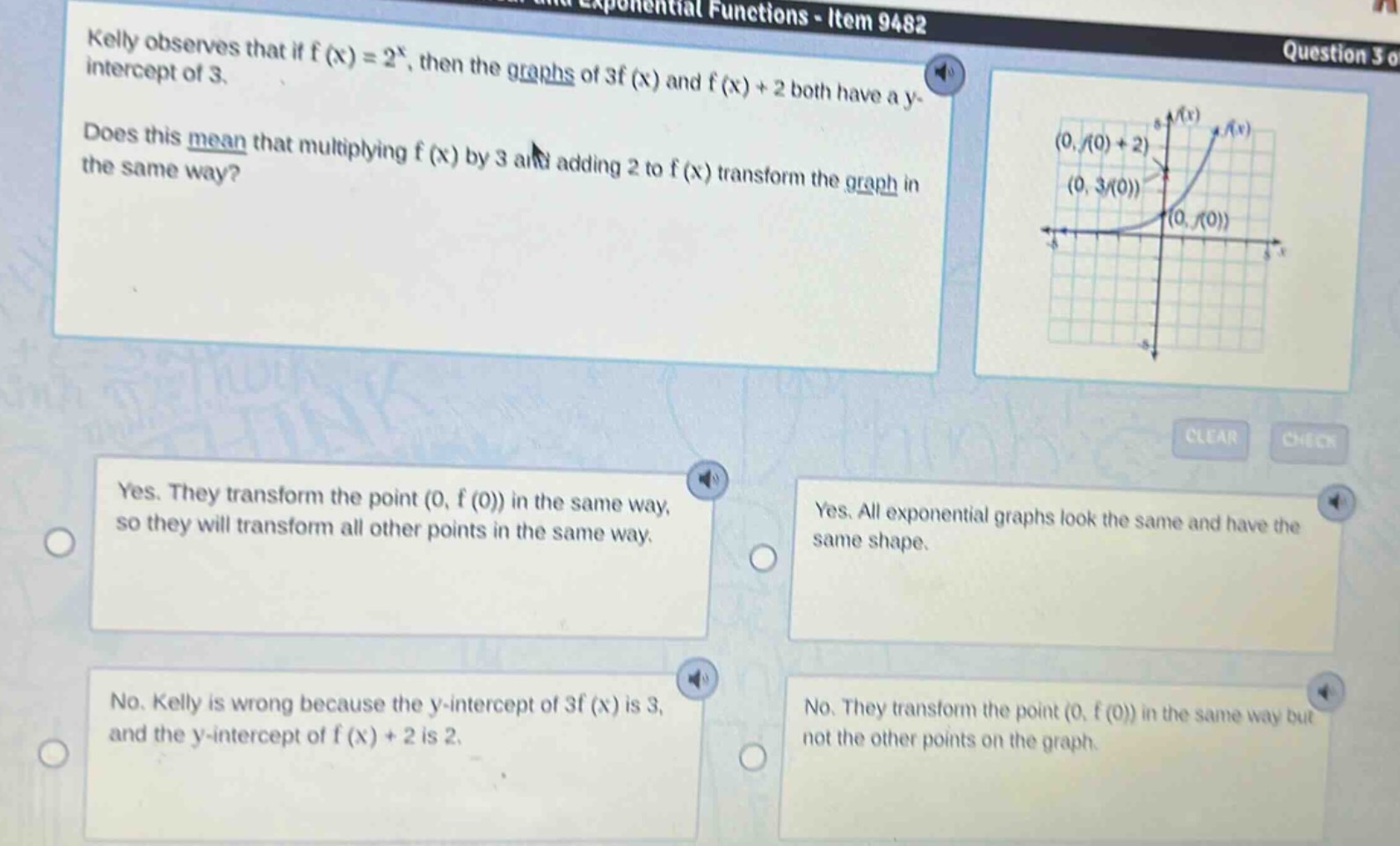
kelly observes that if f(x)=2^x, then the graphs of 3f(x) and f(x)+2 both have a y - intercept of 3. does this mean that multiplying f(x) by 3 and adding 2 to f(x) transform the graph in the same way? yes. they transform the point (0, f(0)) in the same way, so they will transform all other points in the same way. yes. all exponential graphs look the same and have the same shape. no. kelly is wrong because the y - intercept of 3f(x) is 3, and the y - intercept of f(x)+2 is 2. no. they transform the point (0, f(0)) in the same way but not the other points on the graph.
Answer
Explanation:
Step1: Find y - intercept of (3f(x))
Given (f(x)=2^{x}), then (3f(x) = 3\times2^{x}). When (x = 0), (3f(0)=3\times2^{0}=3\times1 = 3).
Step2: Find y - intercept of (f(x)+2)
Given (f(x)=2^{x}), then (f(x)+2=2^{x}+2). When (x = 0), (f(0)+2=2^{0}+2=1 + 2=3).
Step3: Analyze general transformation
For (y = 3f(x)=3\times2^{x}), it is a vertical stretch of (y = f(x)) by a factor of 3. For (y=f(x)+2=2^{x}+2), it is a vertical shift of (y = f(x)) up by 2 units. They transform the point ((0,f(0))) the same way (both result in (y = 3) at (x = 0)), but for other (x) - values, the transformations are different. For example, when (x = 1), (f(1)=2^{1}=2), (3f(1)=3\times2 = 6) and (f(1)+2=2 + 2=4).
Answer:
No. They transform the point ((0,f(0))) in the same way but not the other points on the graph.