lab 16: series tests ap calculus bc name: due (no exceptions): for questions 1 - 15, show all work clearly…
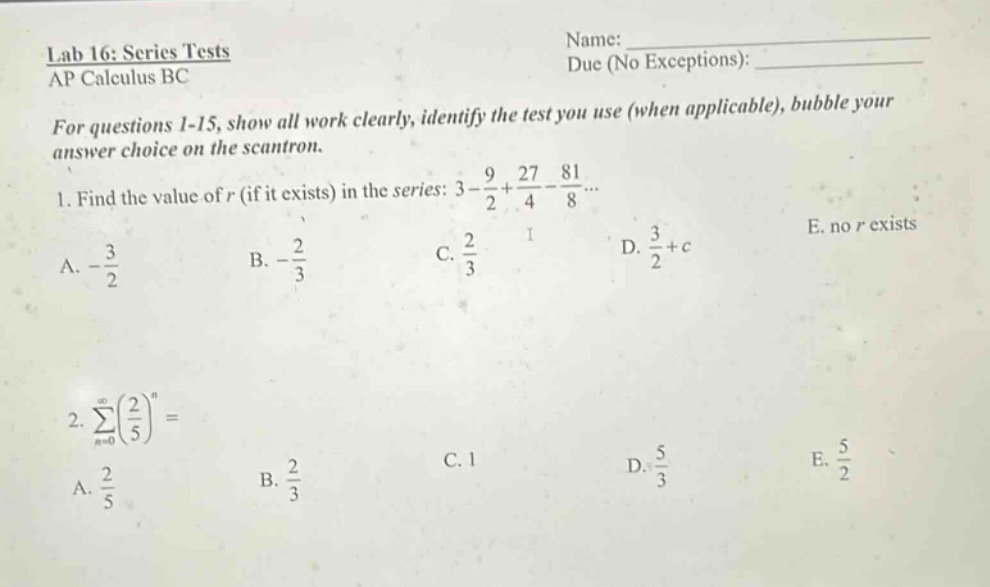
lab 16: series tests ap calculus bc name: due (no exceptions): for questions 1 - 15, show all work clearly, identify the test you use (when applicable), bubble your answer choice on the scantron. 1. find the value of r (if it exists) in the series: 3 - 9/2 + 27/4 - 81/8... a. -3/2 b. -2/3 c. 2/3 d. 3/2 + c e. no r exists 2. ∑(n = 0 to ∞)(2/5)^n = a. 2/5 b. 2/3 c. 1 d. 5/3 e. 5/2
Answer
Explanation:
Step1: Identify the common - ratio formula for a geometric series
For a geometric series (a + ar+ar^{2}+\cdots), the common - ratio (r=\frac{a_{n + 1}}{a_{n}}), where (a_{n}) is the (n)th term and (a_{n+1}) is the ((n + 1))th term.
Step2: Find the common - ratio for the series (3-\frac{9}{2}+\frac{27}{4}-\frac{81}{8}+\cdots)
Let (a_{1}=3) and (a_{2}=-\frac{9}{2}). Then (r=\frac{a_{2}}{a_{1}}=\frac{-\frac{9}{2}}{3}=-\frac{3}{2}).
Step3: Recall the sum formula for an infinite geometric series
The sum of an infinite geometric series (\sum_{n = 0}^{\infty}ar^{n}=\frac{a}{1 - r}), where (|r|\lt1). For the series (\sum_{n=0}^{\infty}(\frac{2}{5})^{n}), we have (a = 1) (when (n = 0), ((\frac{2}{5})^{0}=1)) and (r=\frac{2}{5}).
Step4: Calculate the sum of the series (\sum_{n=0}^{\infty}(\frac{2}{5})^{n})
Using the formula (\sum_{n = 0}^{\infty}ar^{n}=\frac{a}{1 - r}), substituting (a = 1) and (r=\frac{2}{5}), we get (\frac{1}{1-\frac{2}{5}}=\frac{1}{\frac{3}{5}}=\frac{5}{3}).
Answer:
- A. (-\frac{3}{2})
- D. (\frac{5}{3})