laura and becky are each graphing a transformation of the parent cosine function. lauras function is a…
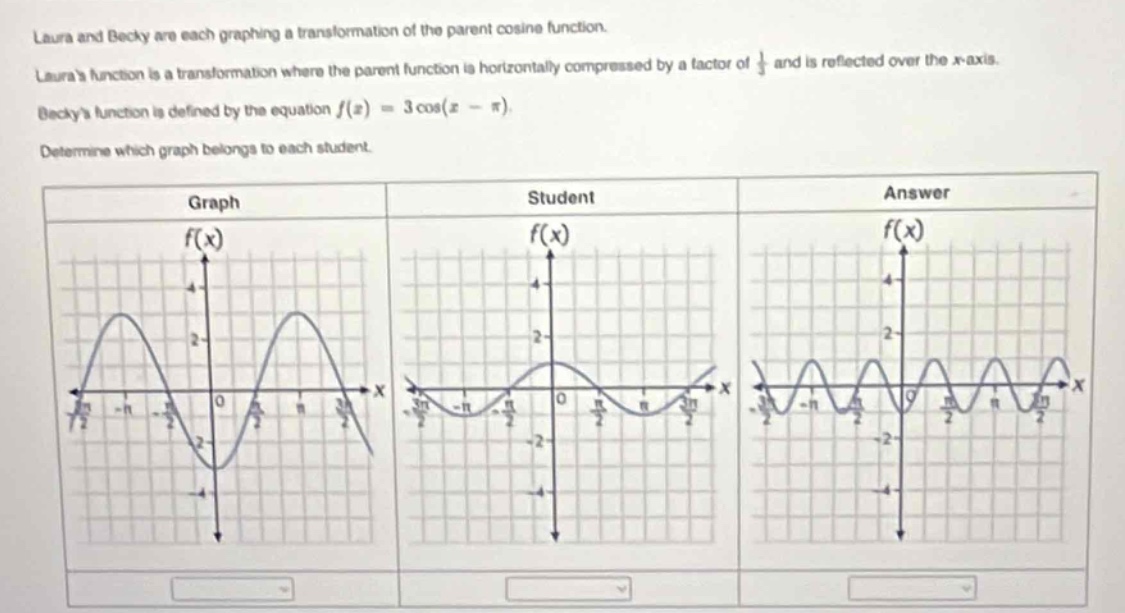
laura and becky are each graphing a transformation of the parent cosine function. lauras function is a transformation where the parent function is horizontally compressed by a factor of ⅓ and is reflected over the x - axis. beckys function is defined by the equation $f(x)=3cos(x - pi)$. determine which graph belongs to each student.
Answer
Explanation:
Step1: Write Laura's function
The parent - cosine function is $y = \cos(x)$. A horizontal compression by a factor of $\frac{1}{3}$ gives $y=\cos(3x)$, and a reflection over the $x$ - axis gives $y =-\cos(3x)$. The period of $y = \cos(x)$ is $2\pi$, and the period of $y=-\cos(3x)$ is $\frac{2\pi}{3}$ (using the formula $T=\frac{2\pi}{|b|}$, where $b = 3$ in $y = A\cos(bx + c)+d$).
Step2: Analyze Becky's function
Becky's function is $f(x)=3\cos(x - \pi)$. Using the phase - shift formula $y = A\cos(bx - c)+d$, here $A = 3$, $b = 1$, $c=\pi$, $d = 0$. The period of $y = 3\cos(x-\pi)$ is $T=\frac{2\pi}{|b|}=2\pi$ (since $b = 1$), and it is a cosine function with an amplitude of $3$ and a phase shift of $\pi$ to the right.
Step3: Match the graphs
The graph with a period of $\frac{2\pi}{3}$ (more frequent waves) belongs to Laura, and the graph with a period of $2\pi$ and an amplitude of $3$ belongs to Becky. The first graph has a period of $2\pi$ and amplitude of $3$, so it is Becky's. The second graph has a period of $2\pi$ and amplitude of $1$, so it is neither. The third graph has a period of $\frac{2\pi}{3}$, so it is Laura's.
Answer:
First graph: Becky Second graph: Neither Third graph: Laura