laura is driving a racecar. the table below gives the distance d(t) (in meters) she has driven at a few…
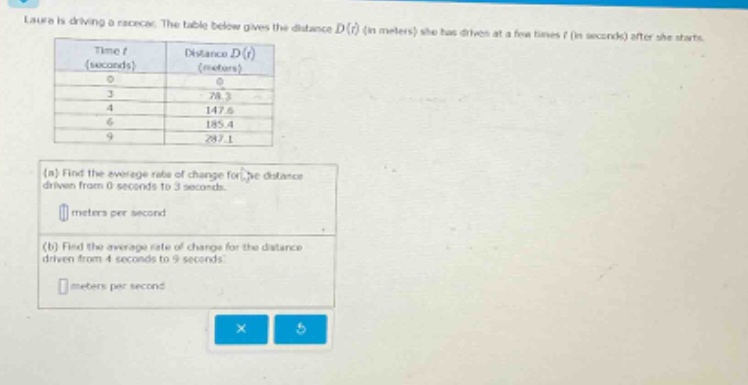
laura is driving a racecar. the table below gives the distance d(t) (in meters) she has driven at a few times t (in seconds) after she starts. time t (seconds) distance d(t) (meters) 0 0 3 78.3 4 147.6 6 185.4 9 287.1 (a) find the average rate of change for the distance driven from 0 seconds to 3 seconds. meters per second (b) find the average rate of change for the distance driven from 4 seconds to 9 seconds. meters per second
Answer
Explanation:
Step1: Recall average rate - of - change formula
The average rate of change of a function $y = f(x)$ over the interval $[a,b]$ is $\frac{f(b)-f(a)}{b - a}$. For the distance function $D(t)$, the average rate of change over the interval $[a,b]$ is $\frac{D(b)-D(a)}{b - a}$.
Step2: Calculate average rate of change for part (a)
We want to find the average rate of change of $D(t)$ from $t = 0$ to $t = 3$. Here, $a = 0$, $b = 3$, $D(0)=0$, and $D(3)=78.3$. Using the formula $\frac{D(3)-D(0)}{3 - 0}=\frac{78.3-0}{3}=\frac{78.3}{3}=26.1$.
Step3: Calculate average rate of change for part (b)
We want to find the average rate of change of $D(t)$ from $t = 4$ to $t = 9$. Here, $a = 4$, $b = 9$, $D(4)=147.6$, and $D(9)=287.1$. Using the formula $\frac{D(9)-D(4)}{9 - 4}=\frac{287.1-147.6}{5}=\frac{139.5}{5}=27.9$.
Answer:
(a) 26.1 (b) 27.9