at least one of the answers above is not correct. consider the function shown in the following graph. assume…
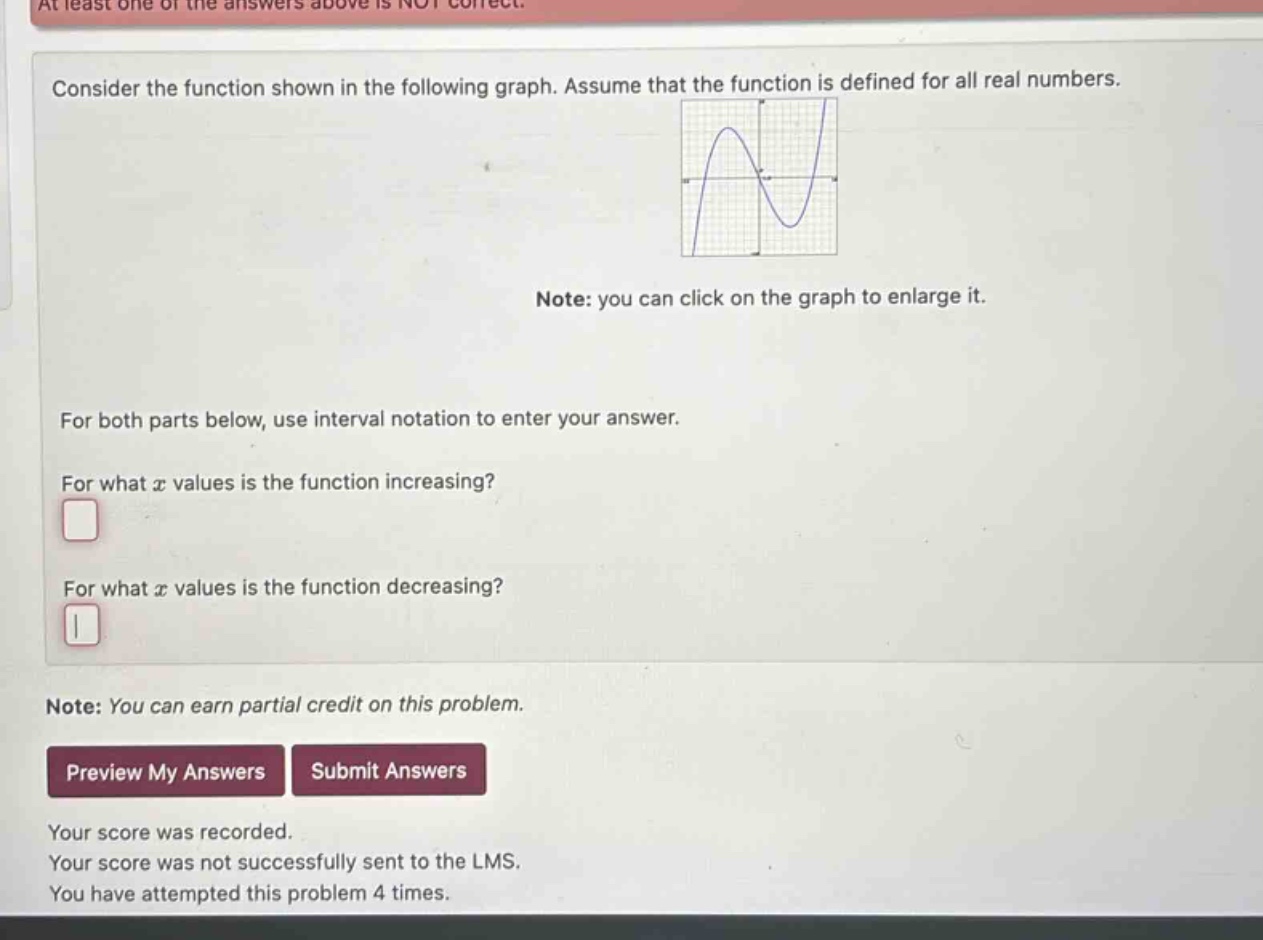
at least one of the answers above is not correct. consider the function shown in the following graph. assume that the function is defined for all real numbers. note: you can click on the graph to enlarge it. for both parts below, use interval notation to enter your answer. for what x values is the function increasing? for what x values is the function decreasing? note: you can earn partial credit on this problem. preview my answers submit answers your score was recorded. your score was not successfully sent to the lms. you have attempted this problem 4 times.
Answer
Explanation:
Step1: Recall increasing - decreasing function concept
A function (y = f(x)) is increasing when the slope of the tangent line is positive and decreasing when the slope of the tangent line is negative. Looking at the graph, we identify the intervals.
Step2: Find increasing intervals
From the graph, the function is increasing when moving from left - to - right and the (y) - values are getting larger. The increasing intervals are ((-\infty,a)\cup(b,\infty)) (assuming the local minimum occurs at (x = b) and local maximum occurs at (x=a)). Let's assume from the graph that the local maximum is at (x=- 1) and local minimum is at (x = 1). So the increasing intervals are ((-\infty,-1)\cup(1,\infty)).
Step3: Find decreasing intervals
The function is decreasing when moving from left - to - right and the (y) - values are getting smaller. The decreasing interval is ((-1,1)).
Answer:
Increasing: ((-\infty,-1)\cup(1,\infty)) Decreasing: ((-1,1))