1. if ( f(x)=left(2 x^{2}+5\right)^{7} ), then ( f^{prime}(x)= )\n(a) ( 7(4 x)^{6} )\n(b) ( 7left(2…
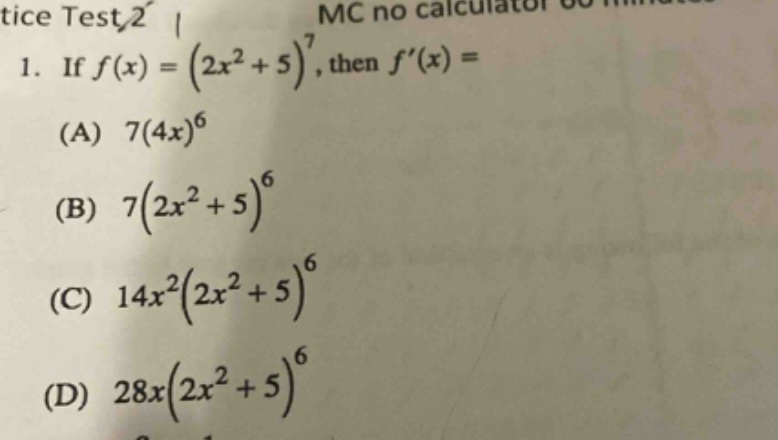
1. if ( f(x)=left(2 x^{2}+5\right)^{7} ), then ( f^{prime}(x)= )\n(a) ( 7(4 x)^{6} )\n(b) ( 7left(2 x^{2}+5\right)^{6} )\n(c) ( 14 x^{2}left(2 x^{2}+5\right)^{6} )\n(d) ( 28 xleft(2 x^{2}+5\right)^{6} )
Answer
Explanation:
Step1: Apply the chain rule
Let (u = 2x^{2}+5), then (y = u^{7}). The chain rule states that (\frac{dy}{dx}=\frac{dy}{du}\cdot\frac{du}{dx}). First, find (\frac{dy}{du}): If (y = u^{7}), then (\frac{dy}{du}=7u^{6}). Second, find (\frac{du}{dx}): If (u = 2x^{2}+5), then (\frac{du}{dx}=4x).
Step2: Substitute (u) and calculate (\frac{dy}{dx})
Substitute (u = 2x^{2}+5) into (\frac{dy}{du}), we get (\frac{dy}{du}=7(2x^{2}+5)^{6}). Then (\frac{dy}{dx}=\frac{dy}{du}\cdot\frac{du}{dx}=7(2x^{2}+5)^{6}\cdot4x). Simplify (7(2x^{2}+5)^{6}\cdot4x): (7\times4x(2x^{2}+5)^{6}=28x(2x^{2}+5)^{6}).
Answer:
D. (28x(2x^{2}+5)^{6})