the length of a rectangle is increasing at a rate of 4 cm/s and its width is increasing at a rate of 3 cm/s…
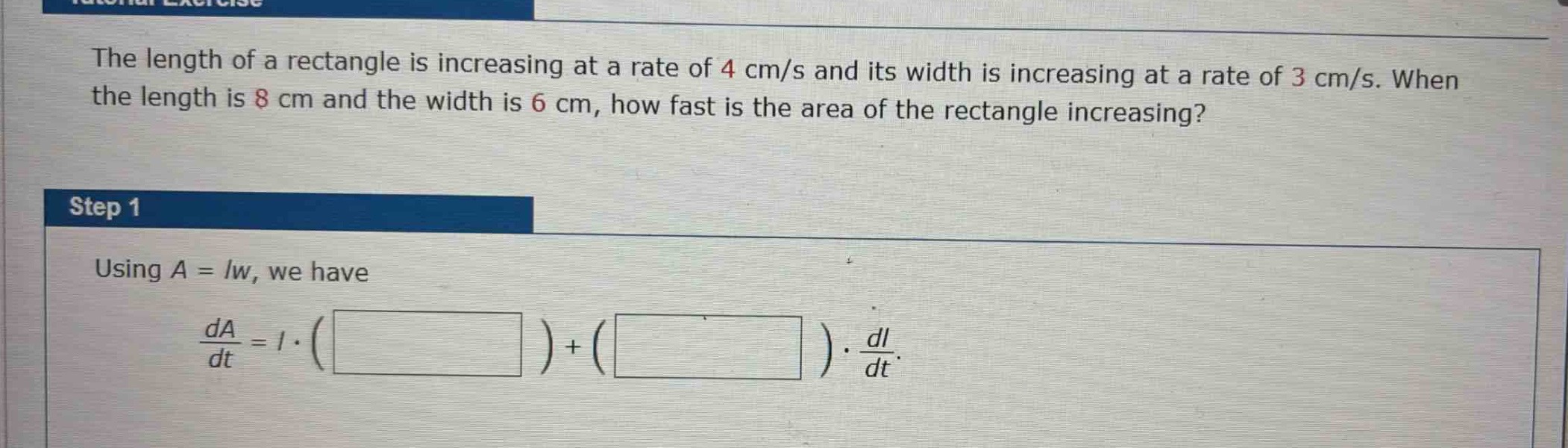
the length of a rectangle is increasing at a rate of 4 cm/s and its width is increasing at a rate of 3 cm/s. when the length is 8 cm and the width is 6 cm, how fast is the area of the rectangle increasing?\nstep 1\nusing (a = lw), we have\n(\frac{da}{dt}=lcdot(square)+(square)cdot\frac{dl}{dt}).
Answer
Explanation:
Step1: Differentiate area formula
We know the area of a rectangle $A = lw$. Using the product - rule for differentiation $\frac{d(uv)}{dt}=u\frac{dv}{dt}+v\frac{du}{dt}$, where $u = l$ and $v = w$. So $\frac{dA}{dt}=l\cdot\frac{dw}{dt}+w\cdot\frac{dl}{dt}$.
Step2: Substitute given values
We are given that $\frac{dl}{dt}=4$ cm/s, $\frac{dw}{dt}=3$ cm/s, $l = 8$ cm and $w = 6$ cm. Substitute these values into the formula: $\frac{dA}{dt}=8\times3 + 6\times4$.
Step3: Calculate the result
$\frac{dA}{dt}=24 + 24=48$ cm²/s.
Answer:
48 cm²/s