lesson 18.1 checkpoint\nonce you have completed the above problems and checked your solutions, complete the…
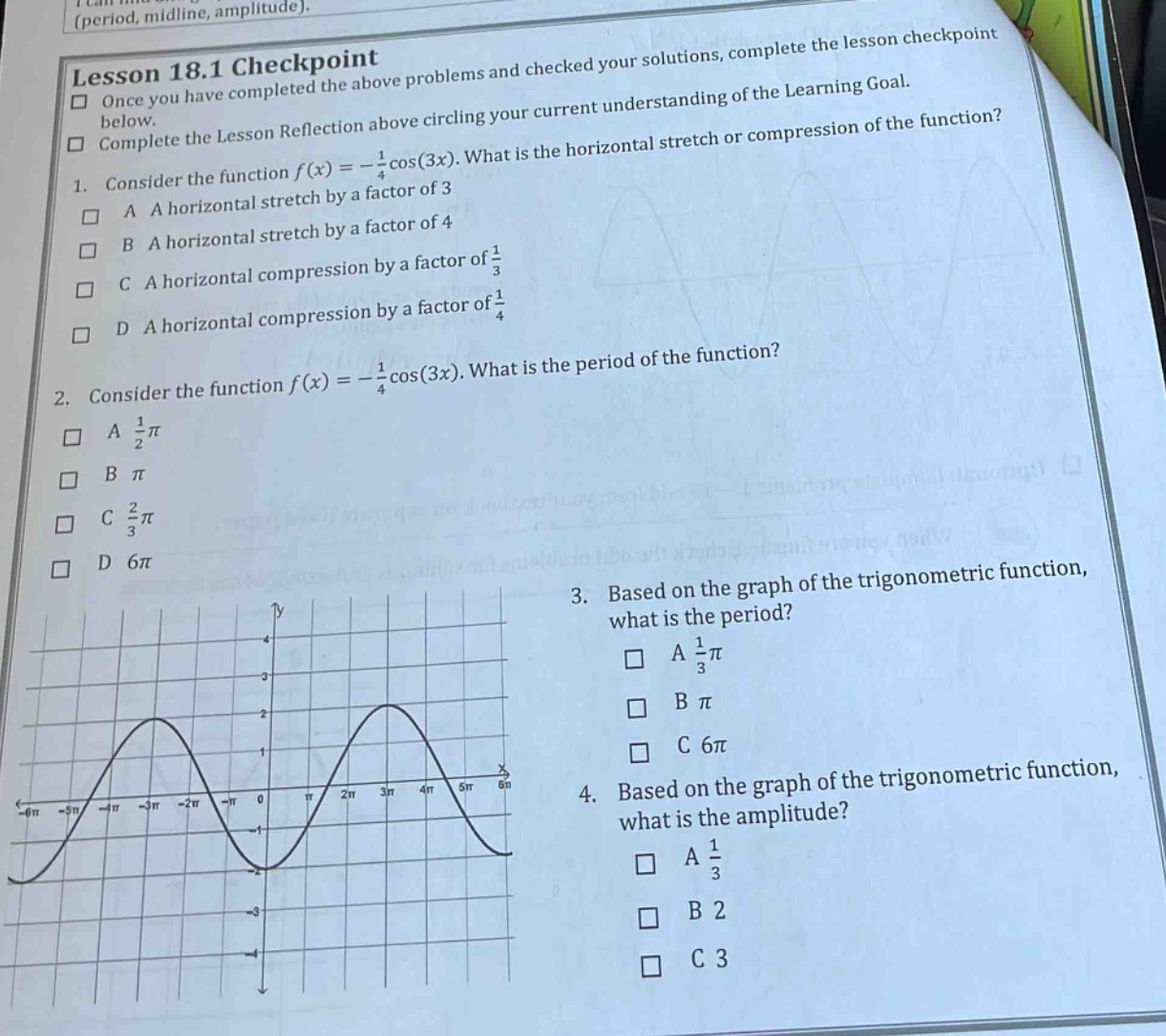
lesson 18.1 checkpoint\nonce you have completed the above problems and checked your solutions, complete the lesson checkpoint below.\ncomplete the lesson reflection above circling your current understanding of the learning goal.\n1. consider the function f(x)=-1/4cos(3x). what is the horizontal stretch or compression of the function?\na a horizontal stretch by a factor of 3\nb a horizontal stretch by a factor of 4\nc a horizontal compression by a factor of 1/3\nd a horizontal compression by a factor of 1/4\n2. consider the function f(x)=-1/4cos(3x). what is the period of the function?\na 1/2π\nb π\nc 2/3π\nd 6π\n3. based on the graph of the trigonometric function, what is the period?\na 1/3π\nb π\nc 6π\n4. based on the graph of the trigonometric function, what is the amplitude?\na 1/3\nb 2\nc 3
Answer
Explanation:
Step1: Recall horizontal - stretch/compression rule
For a function $y = f(bx)$, if $b>1$, it's a horizontal compression by a factor of $\frac{1}{b}$; if $0 < b<1$, it's a horizontal stretch by a factor of $\frac{1}{b}$. For $y =-\frac{1}{4}\cos(3x)$, $b = 3>1$, so it's a horizontal compression by a factor of $\frac{1}{3}$.
Step2: Recall period formula for cosine
The general form of a cosine function is $y = A\cos(Bx - C)+D$, and its period $T=\frac{2\pi}{|B|}$. For $y =-\frac{1}{4}\cos(3x)$, $B = 3$, so $T=\frac{2\pi}{3}$.
Step3: Analyze period from graph
Count the horizontal distance between two consecutive peaks or troughs. From the graph, the period is $2\pi$. But this part seems to have a mismatch with the function in previous questions. Assuming we focus on the function $y =-\frac{1}{4}\cos(3x)$, the period is $\frac{2\pi}{3}$.
Step4: Recall amplitude formula
For the function $y = A\cos(Bx - C)+D$, the amplitude is $|A|$. For $y =-\frac{1}{4}\cos(3x)$, $A=-\frac{1}{4}$, so the amplitude is $\frac{1}{4}$. But from the graph, if we consider the vertical distance from the mid - line to the peak/trough, the amplitude is 2.
Answer:
- C. A horizontal compression by a factor of $\frac{1}{3}$
- C. $\frac{2}{3}\pi$
- (Based on the function $y =-\frac{1}{4}\cos(3x)$) C. $\frac{2}{3}\pi$
- B. 2