lessons 5 - 6\n9. the distance, d(t), in meters, a ball travels after t seconds can be modeled by the…
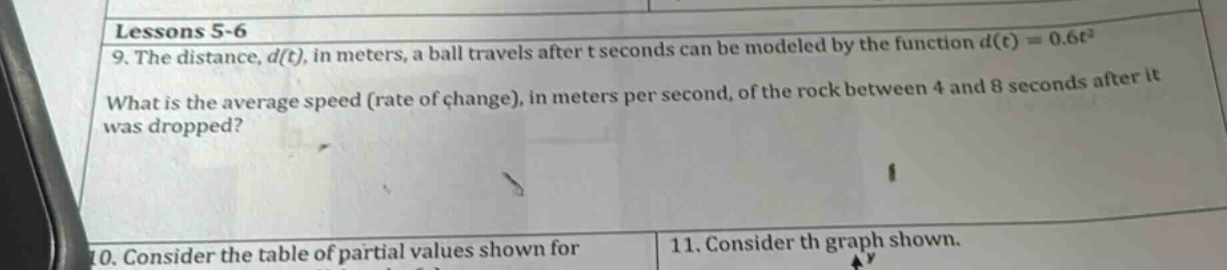
lessons 5 - 6\n9. the distance, d(t), in meters, a ball travels after t seconds can be modeled by the function d(t)=0.6t²\nwhat is the average speed (rate of change), in meters per second, of the rock between 4 and 8 seconds after it was dropped?\n10. consider the table of partial values shown for\n11. consider th graph shown.
Answer
Explanation:
Step1: Recall average - rate - of - change formula
The average rate of change of a function $y = f(x)$ over the interval $[a,b]$ is $\frac{f(b)-f(a)}{b - a}$. Here, $d(t)=0.6t^{2}$, $a = 4$, and $b = 8$.
Step2: Calculate $d(8)$ and $d(4)$
$d(8)=0.6\times8^{2}=0.6\times64 = 38.4$; $d(4)=0.6\times4^{2}=0.6\times16 = 9.6$.
Step3: Calculate the average rate of change
The average rate of change is $\frac{d(8)-d(4)}{8 - 4}=\frac{38.4 - 9.6}{4}=\frac{28.8}{4}=7.2$.
Answer:
$7.2$