let f(x) = { (x^2 - 100)/(x + 10) if x < 0; (x^2 - 100)/(x - 10) if x > 0 }. find a) lim(x→ - 10) f(x), b)…
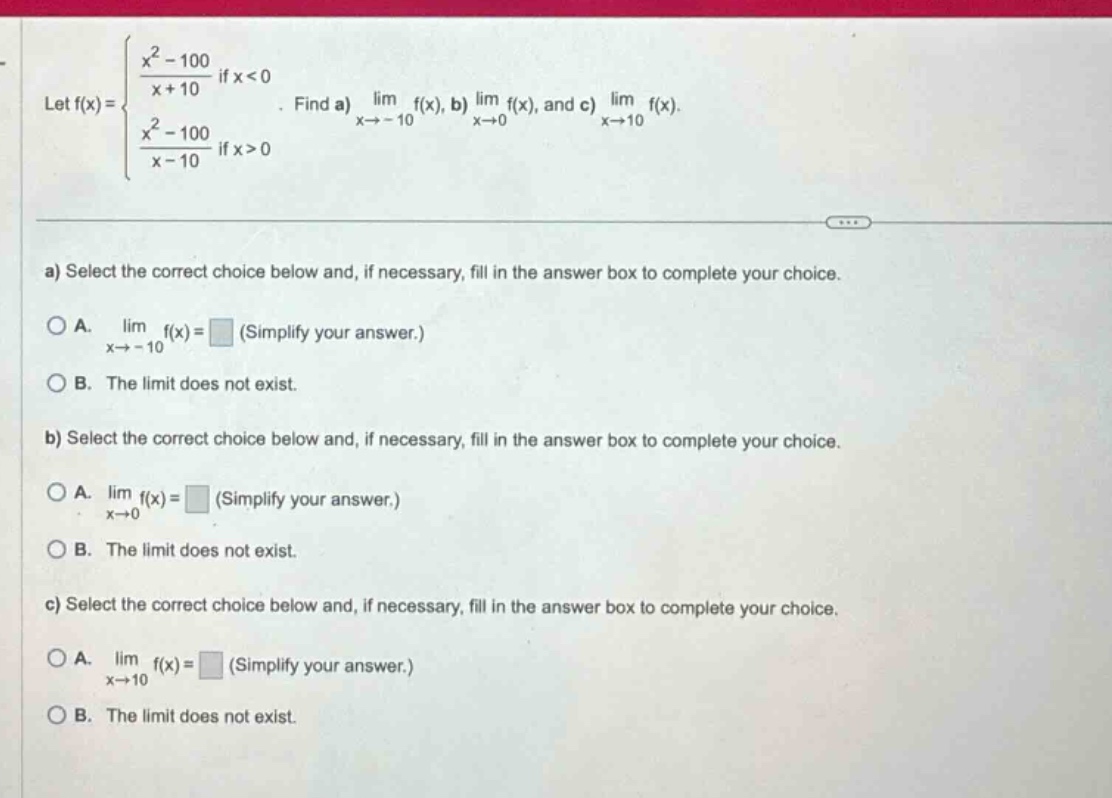
let f(x) = { (x^2 - 100)/(x + 10) if x < 0; (x^2 - 100)/(x - 10) if x > 0 }. find a) lim(x→ - 10) f(x), b) lim(x→0) f(x), and c) lim(x→10) f(x). a) select the correct choice below and, if necessary, fill in the answer box to complete your choice. a. lim(x→ - 10) f(x) = (simplify your answer.) b. the limit does not exist. b) select the correct choice below and, if necessary, fill in the answer box to complete your choice. a. lim(x→0) f(x) = (simplify your answer.) b. the limit does not exist. c) select the correct choice below and, if necessary, fill in the answer box to complete your choice. a. lim(x→10) f(x) = (simplify your answer.) b. the limit does not exist.
Answer
Explanation:
Step1: Simplify the function for (x < 0)
For (x<0), (f(x)=\frac{x^{2}-100}{x + 10}=\frac{(x + 10)(x - 10)}{x+10}=x - 10) (for (x\neq - 10)).
Step2: Calculate (\lim_{x\rightarrow - 10}f(x))
(\lim_{x\rightarrow - 10}f(x)=\lim_{x\rightarrow - 10}(x - 10)=-10-10=-20). So for part a), the answer is A. (\lim_{x\rightarrow - 10}f(x)=-20).
Step3: Analyze the left - hand and right - hand limits as (x\rightarrow0)
Left - hand limit ((x\rightarrow0^{-})): (f(x)=x - 10), (\lim_{x\rightarrow0^{-}}f(x)=0 - 10=-10). Right - hand limit ((x\rightarrow0^{+})): (f(x)=\frac{x^{2}-100}{x - 10}=\frac{(x + 10)(x - 10)}{x - 10}=x + 10) (for (x\neq10)), (\lim_{x\rightarrow0^{+}}f(x)=0 + 10=10). Since (\lim_{x\rightarrow0^{-}}f(x)\neq\lim_{x\rightarrow0^{+}}f(x)), for part b), the answer is B. The limit does not exist.
Step4: Analyze the limit as (x\rightarrow10)
For (x>0), (f(x)=\frac{x^{2}-100}{x - 10}=\frac{(x + 10)(x - 10)}{x - 10}=x + 10) (for (x\neq10)). (\lim_{x\rightarrow10}f(x)=\lim_{x\rightarrow10}(x + 10)=10+10 = 20). So for part c), the answer is A. (\lim_{x\rightarrow10}f(x)=20).
Answer:
a) A. (\lim_{x\rightarrow - 10}f(x)=-20) b) B. The limit does not exist. c) A. (\lim_{x\rightarrow10}f(x)=20)