let f(x)=2x³ + 7x² + 4x - 5. on which intervals is f decreasing? choose 1 answer: a x > -1/3 only b x > -2…
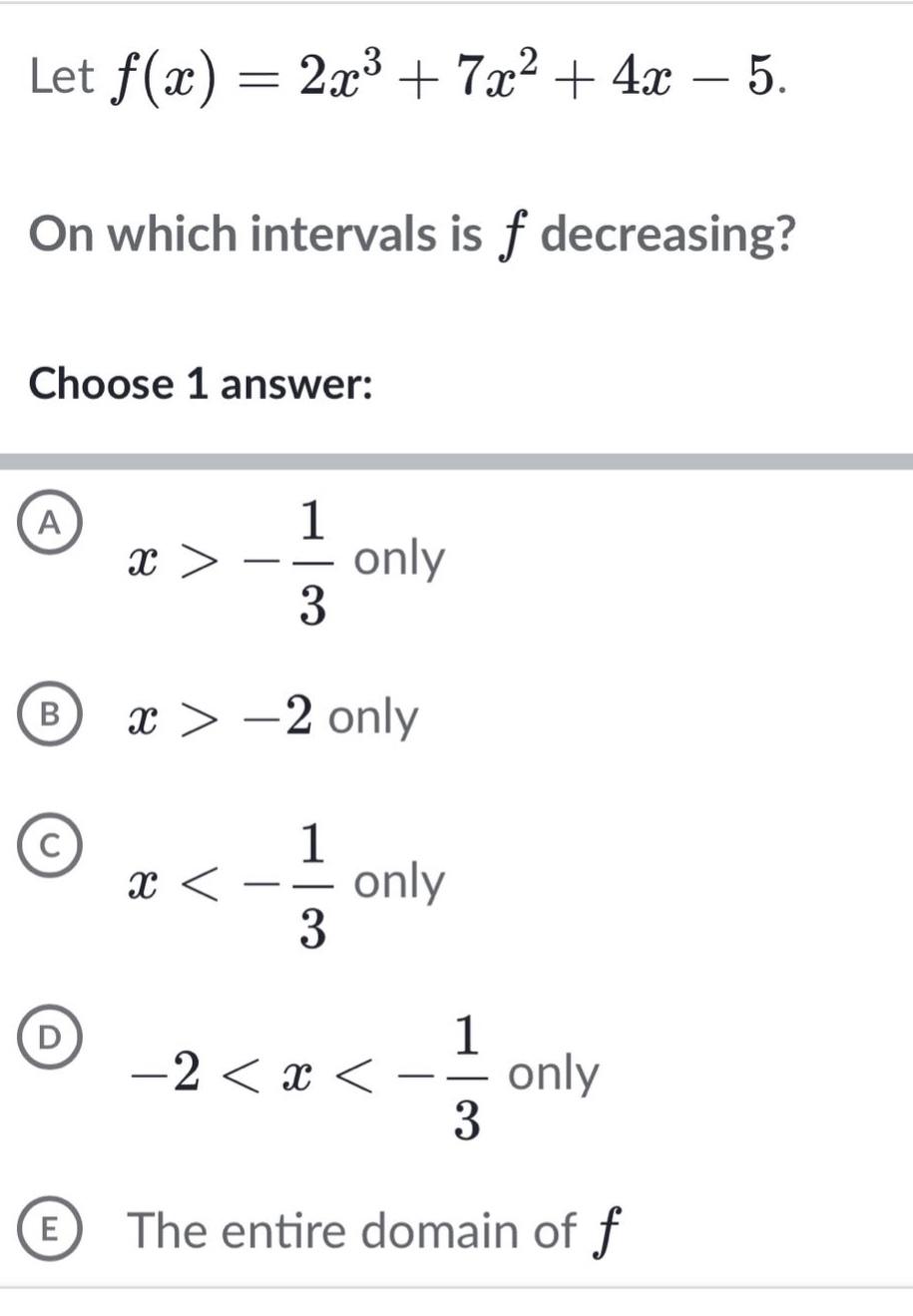
let f(x)=2x³ + 7x² + 4x - 5. on which intervals is f decreasing? choose 1 answer: a x > -1/3 only b x > -2 only c x < -1/3 only d -2 < x < -1/3 only e the entire domain of f
Answer
Explanation:
Step1: Find the derivative
Differentiate $f(x)=2x^{3}+7x^{2}+4x - 5$ using power - rule. $f^\prime(x)=6x^{2}+14x + 4$.
Step2: Simplify the derivative
Factor out a 2: $f^\prime(x)=2(3x^{2}+7x + 2)$.
Step3: Factor the quadratic
Factor $3x^{2}+7x + 2$ as $(3x + 1)(x+2)$. So $f^\prime(x)=2(3x + 1)(x + 2)$.
Step4: Find critical points
Set $f^\prime(x)=0$. Then $(3x + 1)(x + 2)=0$. Solving gives $x=-2$ and $x=-\frac{1}{3}$.
Step5: Test intervals
Test intervals $(-\infty,-2)$, $(-2,-\frac{1}{3})$, and $(-\frac{1}{3},\infty)$ using a test - point in each interval. For $x<-2$, let $x=-3$. Then $f^\prime(-3)=2(-9 + 1)(-3+2)=16>0$. For $-2<x<-\frac{1}{3}$, let $x = - 1$. Then $f^\prime(-1)=2(-3 + 1)(-1+2)=-4<0$. For $x>-\frac{1}{3}$, let $x = 0$. Then $f^\prime(0)=2(1)(2)=4>0$. The function $f(x)$ is decreasing when $f^\prime(x)<0$.
Answer:
D. $-2 < x<-\frac{1}{3}$ only