let f(x) = (2x² - 9x - 5)/(x² + x - 30). find the indicated quantities, if they exist. (a) lim f(x) as x→5…
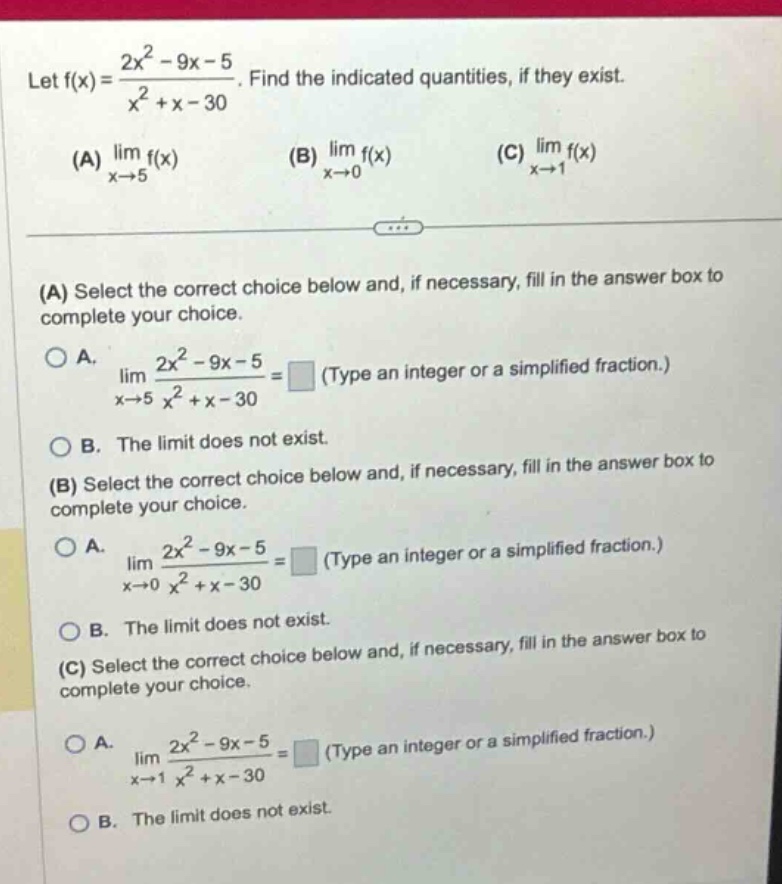
let f(x) = (2x² - 9x - 5)/(x² + x - 30). find the indicated quantities, if they exist. (a) lim f(x) as x→5 (b) lim f(x) as x→0 (c) lim f(x) as x→1 (a) select the correct choice below and, if necessary, fill in the answer box to complete your choice. a. lim (2x² - 9x - 5)/(x² + x - 30) as x→5 = (type an integer or a simplified fraction.) b. the limit does not exist. (b) select the correct choice below and, if necessary, fill in the answer box to complete your choice. a. lim (2x² - 9x - 5)/(x² + x - 30) as x→0 = (type an integer or a simplified fraction.) b. the limit does not exist. (c) select the correct choice below and, if necessary, fill in the answer box to complete your choice. a. lim (2x² - 9x - 5)/(x² + x - 30) as x→1 = (type an integer or a simplified fraction.) b. the limit does not exist.
Answer
Explanation:
Step1: Factor the numerator and denominator
First, factor (2x^{2}-9x - 5=(2x + 1)(x - 5)) and (x^{2}+x - 30=(x + 6)(x - 5)). So (f(x)=\frac{(2x + 1)(x - 5)}{(x + 6)(x - 5)}=\frac{2x+1}{x + 6}) for (x\neq5).
Step2: Calculate (\lim_{x\rightarrow5}f(x))
Substitute (x = 5) into (\frac{2x+1}{x + 6}). We get (\frac{2\times5+1}{5 + 6}=\frac{10 + 1}{11}=\frac{11}{11}=1).
Step3: Calculate (\lim_{x\rightarrow0}f(x))
Substitute (x = 0) into (\frac{2x+1}{x + 6}). We have (\frac{2\times0+1}{0 + 6}=\frac{1}{6}).
Step4: Calculate (\lim_{x\rightarrow1}f(x))
Substitute (x = 1) into (\frac{2x+1}{x + 6}). We obtain (\frac{2\times1+1}{1+6}=\frac{2 + 1}{7}=\frac{3}{7}).
Answer:
(A) A. (\lim_{x\rightarrow5}\frac{2x^{2}-9x - 5}{x^{2}+x - 30}=1) (B) A. (\lim_{x\rightarrow0}\frac{2x^{2}-9x - 5}{x^{2}+x - 30}=\frac{1}{6}) (C) A. (\lim_{x\rightarrow1}\frac{2x^{2}-9x - 5}{x^{2}+x - 30}=\frac{3}{7})