let f(u)=u^4 and g(x)=u = 2x^6+5. find (f o g)(-1). (f o g)(-1)= (type an exact answer.)
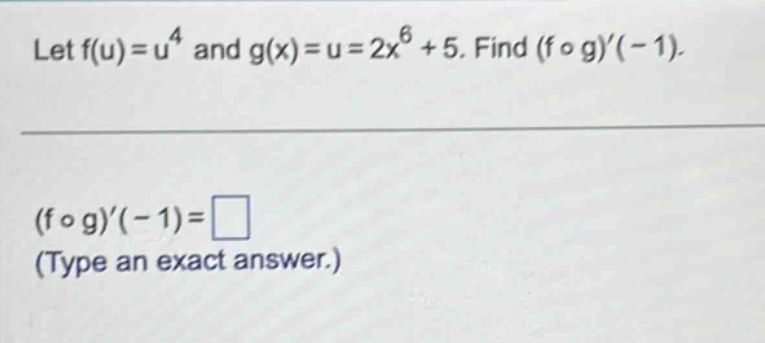
let f(u)=u^4 and g(x)=u = 2x^6+5. find (f o g)(-1). (f o g)(-1)= (type an exact answer.)
Answer
Explanation:
Step1: Recall chain - rule
The chain - rule states that $(f\circ g)'(x)=f'(g(x))\cdot g'(x)$. First, find the derivative of $f(u)$ with respect to $u$. Given $f(u) = u^{4}$, then $f'(u)=\frac{d}{du}(u^{4}) = 4u^{3}$.
Step2: Find the derivative of $g(x)$ with respect to $x$
Given $g(x)=2x^{6}+5$, then $g'(x)=\frac{d}{dx}(2x^{6}+5)=12x^{5}$.
Step3: Find $f'(g(x))$
Substitute $u = g(x)=2x^{6}+5$ into $f'(u)$. So $f'(g(x)) = 4(2x^{6}+5)^{3}$.
Step4: Calculate $(f\circ g)'(x)$
By the chain - rule, $(f\circ g)'(x)=f'(g(x))\cdot g'(x)=4(2x^{6}+5)^{3}\cdot12x^{5}=48x^{5}(2x^{6}+5)^{3}$.
Step5: Evaluate $(f\circ g)'(-1)$
Substitute $x=-1$ into $(f\circ g)'(x)$. When $x = - 1$, we have $2x^{6}+5=2\times(-1)^{6}+5=2 + 5=7$ and $x^{5}=(-1)^{5}=-1$. Then $(f\circ g)'(-1)=48\times(-1)\times7^{3}=-48\times343=-16464$.
Answer:
$-16464$