let f(x)=2x + 2/x. (a) use interval notation to indicate where f(x) is increasing. note: use inf for ∞, -inf…
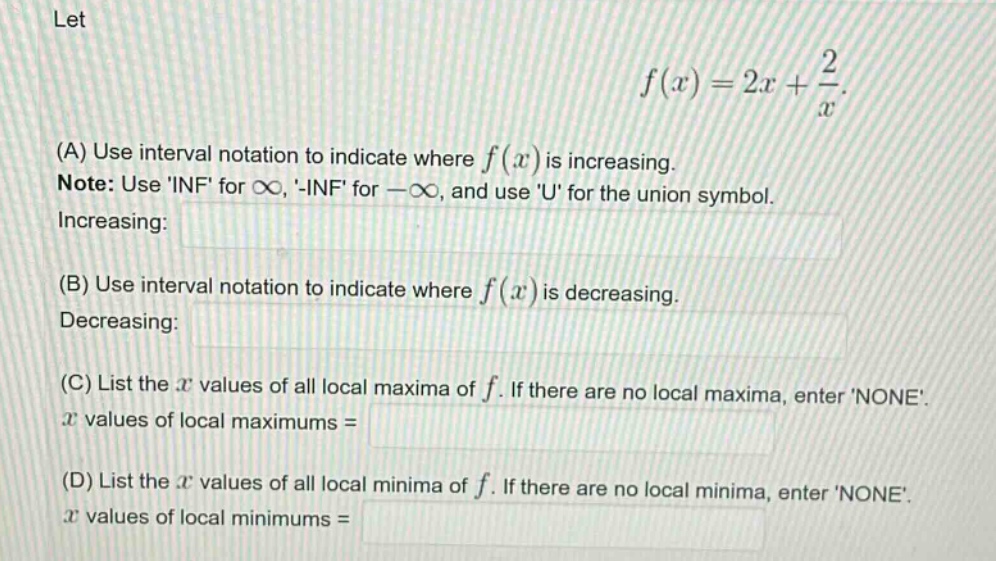
let f(x)=2x + 2/x. (a) use interval notation to indicate where f(x) is increasing. note: use inf for ∞, -inf for -∞, and use u for the union symbol. increasing: (b) use interval notation to indicate where f(x) is decreasing. decreasing: (c) list the x values of all local maxima of f. if there are no local maxima, enter none. x values of local maximums = (d) list the x values of all local minima of f. if there are no local minima, enter none. x values of local minimums =
Answer
Explanation:
Step1: Find the derivative
The derivative of $f(x)=2x+\frac{2}{x}=2x + 2x^{-1}$ using the power - rule $(x^n)'=nx^{n - 1}$ is $f'(x)=2-2x^{-2}=2-\frac{2}{x^{2}}=\frac{2x^{2}-2}{x^{2}}=\frac{2(x^{2}-1)}{x^{2}}=\frac{2(x - 1)(x + 1)}{x^{2}}$, where $x\neq0$.
Step2: Find the critical points
Set $f'(x)=0$, then $\frac{2(x - 1)(x + 1)}{x^{2}}=0$. The numerator $2(x - 1)(x + 1)=0$ gives $x=-1$ or $x = 1$. The function is undefined at $x = 0$.
Step3: Test the intervals
We have the intervals $(-\infty,-1)$, $(-1,0)$, $(0,1)$ and $(1,\infty)$. For $x\in(-\infty,-1)$, let $x=-2$, then $f'(-2)=\frac{2((-2)^{2}-1)}{(-2)^{2}}=\frac{2(4 - 1)}{4}=\frac{3}{2}>0$, so $f(x)$ is increasing on $(-\infty,-1)$. For $x\in(-1,0)$, let $x =-\frac{1}{2}$, then $f'(-\frac{1}{2})=\frac{2((-\frac{1}{2})^{2}-1)}{(-\frac{1}{2})^{2}}=\frac{2(\frac{1}{4}-1)}{\frac{1}{4}}=-6<0$, so $f(x)$ is decreasing on $(-1,0)$. For $x\in(0,1)$, let $x=\frac{1}{2}$, then $f'(\frac{1}{2})=\frac{2((\frac{1}{2})^{2}-1)}{(\frac{1}{2})^{2}}=\frac{2(\frac{1}{4}-1)}{\frac{1}{4}}=-6<0$, so $f(x)$ is decreasing on $(0,1)$. For $x\in(1,\infty)$, let $x = 2$, then $f'(2)=\frac{2(2^{2}-1)}{2^{2}}=\frac{2(4 - 1)}{4}=\frac{3}{2}>0$, so $f(x)$ is increasing on $(1,\infty)$.
Answer:
(A) Increasing: $(-\infty,-1)\cup(1,\infty)$ (B) Decreasing: $(-1,0)\cup(0,1)$ (C) $x$ values of local maximums $=-1$ (D) $x$ values of local minimums $=1$