let f(x)=x^3 + 3x^2+3x + 5. a. calculate the derivative f(x)= b. calculate the second derivative f(x)= c. on…
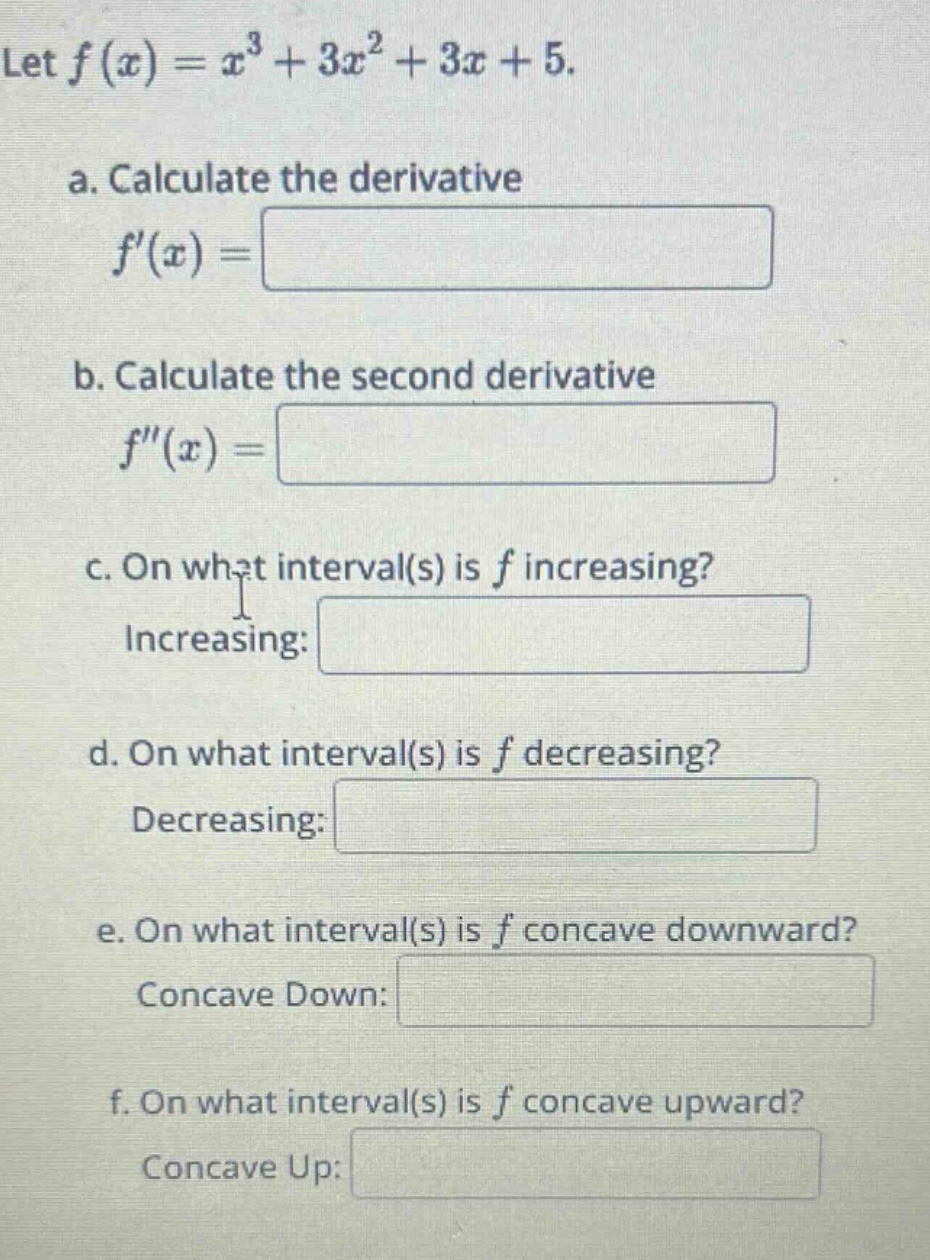
let f(x)=x^3 + 3x^2+3x + 5. a. calculate the derivative f(x)= b. calculate the second derivative f(x)= c. on what interval(s) is f increasing? increasing: d. on what interval(s) is f decreasing? decreasing: e. on what interval(s) is f concave downward? concave down: f. on what interval(s) is f concave upward? concave up:
Answer
Explanation:
Step1: Find the first - derivative
Use the power rule $\frac{d}{dx}(x^n)=nx^{n - 1}$. $f(x)=x^{3}+3x^{2}+3x + 5$ $f'(x)=3x^{2}+6x + 3$
Step2: Find the second - derivative
Differentiate $f'(x)$ using the power rule. $f'(x)=3x^{2}+6x + 3$ $f''(x)=6x+6$
Step3: Find where $f(x)$ is increasing
Set $f'(x)>0$. $3x^{2}+6x + 3>0$ $3(x^{2}+2x + 1)>0$ $3(x + 1)^{2}>0$. Since $(x + 1)^{2}\geq0$ for all real $x$, and $3>0$, $f'(x)>0$ for $x\neq - 1$. The function is increasing on $(-\infty,-1)\cup(-1,\infty)$.
Step4: Find where $f(x)$ is decreasing
Set $f'(x)<0$. Since $f'(x)=3(x + 1)^{2}\geq0$ for all real $x$, there is no interval where $f(x)$ is decreasing.
Step5: Find where $f(x)$ is concave downward
Set $f''(x)<0$. $6x+6<0$ $6x<-6$ $x<-1$. So $f(x)$ is concave downward on $(-\infty,-1)$.
Step6: Find where $f(x)$ is concave upward
Set $f''(x)>0$. $6x + 6>0$ $6x>-6$ $x>-1$. So $f(x)$ is concave upward on $(-1,\infty)$.
Answer:
a. $f'(x)=3x^{2}+6x + 3$ b. $f''(x)=6x + 6$ c. $(-\infty,-1)\cup(-1,\infty)$ d. None e. $(-\infty,-1)$ f. $(-1,\infty)$