let g(x)=√(5x - 1) and let c be the number that satisfies the mean value theorem for g on the interval 1…
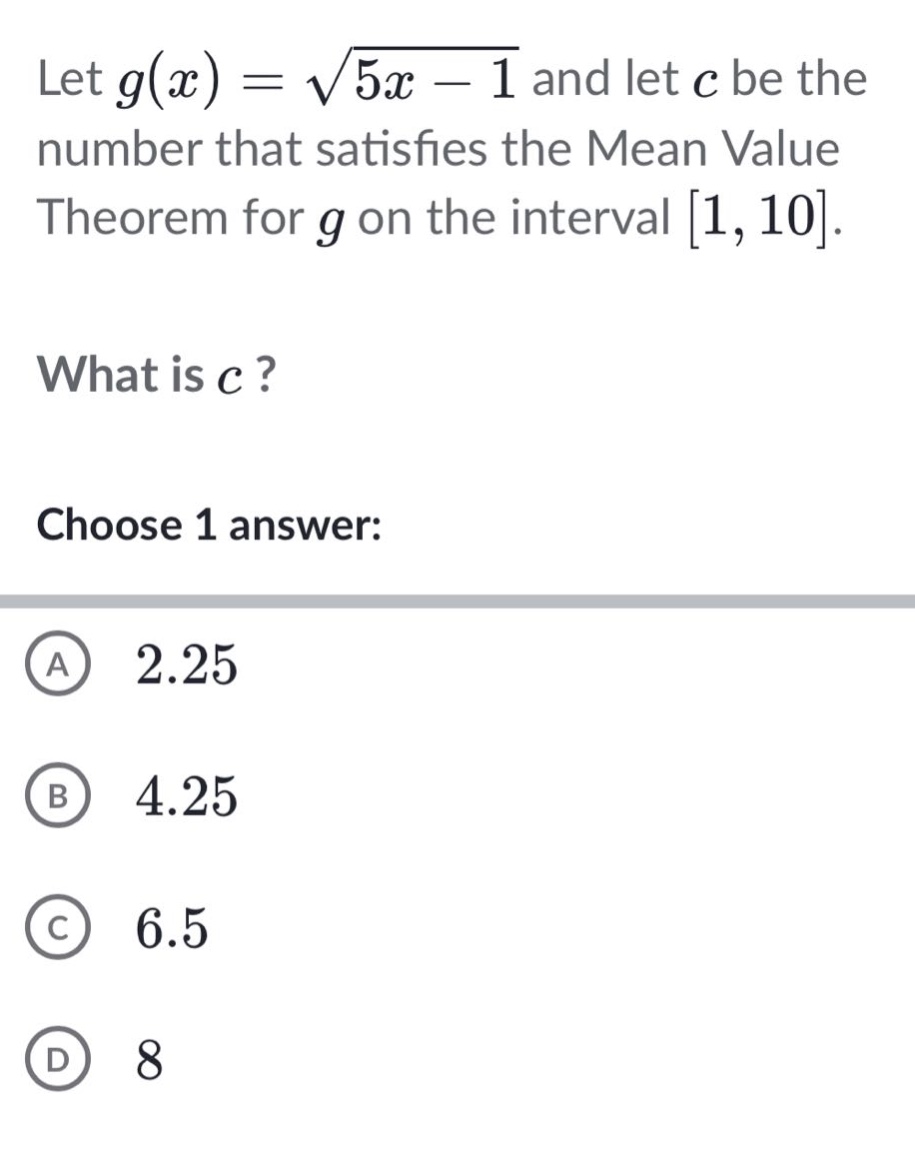
let g(x)=√(5x - 1) and let c be the number that satisfies the mean value theorem for g on the interval 1, 10. what is c? choose 1 answer: a 2.25 b 4.25 c 6.5 d 8
Answer
Explanation:
Step1: Recall Mean - Value Theorem
The Mean - Value Theorem states that if (y = g(x)) is continuous on the closed interval ([a,b]) and differentiable on the open interval ((a,b)), then (g^{\prime}(c)=\frac{g(b)-g(a)}{b - a}), where (a = 1), (b = 10). First, find (g(1)) and (g(10)): [g(1)=\sqrt{5\times1 - 1}=\sqrt{4} = 2] [g(10)=\sqrt{5\times10 - 1}=\sqrt{49}=7] Then (\frac{g(10)-g(1)}{10 - 1}=\frac{7 - 2}{9}=\frac{5}{9})
Step2: Find the derivative of (g(x))
Using the chain - rule, if (g(x)=\sqrt{5x - 1}=(5x - 1)^{\frac{1}{2}}), then (g^{\prime}(x)=\frac{1}{2}(5x - 1)^{-\frac{1}{2}}\times5=\frac{5}{2\sqrt{5x - 1}})
Step3: Set (g^{\prime}(c)) equal to (\frac{g(10)-g(1)}{10 - 1})
We have (\frac{5}{2\sqrt{5c - 1}}=\frac{5}{9}) Cross - multiply to get (2\sqrt{5c - 1}=9) Divide both sides by 2: (\sqrt{5c - 1}=\frac{9}{2}) Square both sides: (5c-1=\frac{81}{4}) Add 1 to both sides: (5c=\frac{81}{4}+1=\frac{81 + 4}{4}=\frac{85}{4}) Solve for (c): (c=\frac{85}{20}=4.25)
Answer:
B. (4.25)