let f(x)=x² - 8x - 9 and f(x)=∫₀ˣ f(t)dt. find the critical points of f and determine whether they are local…
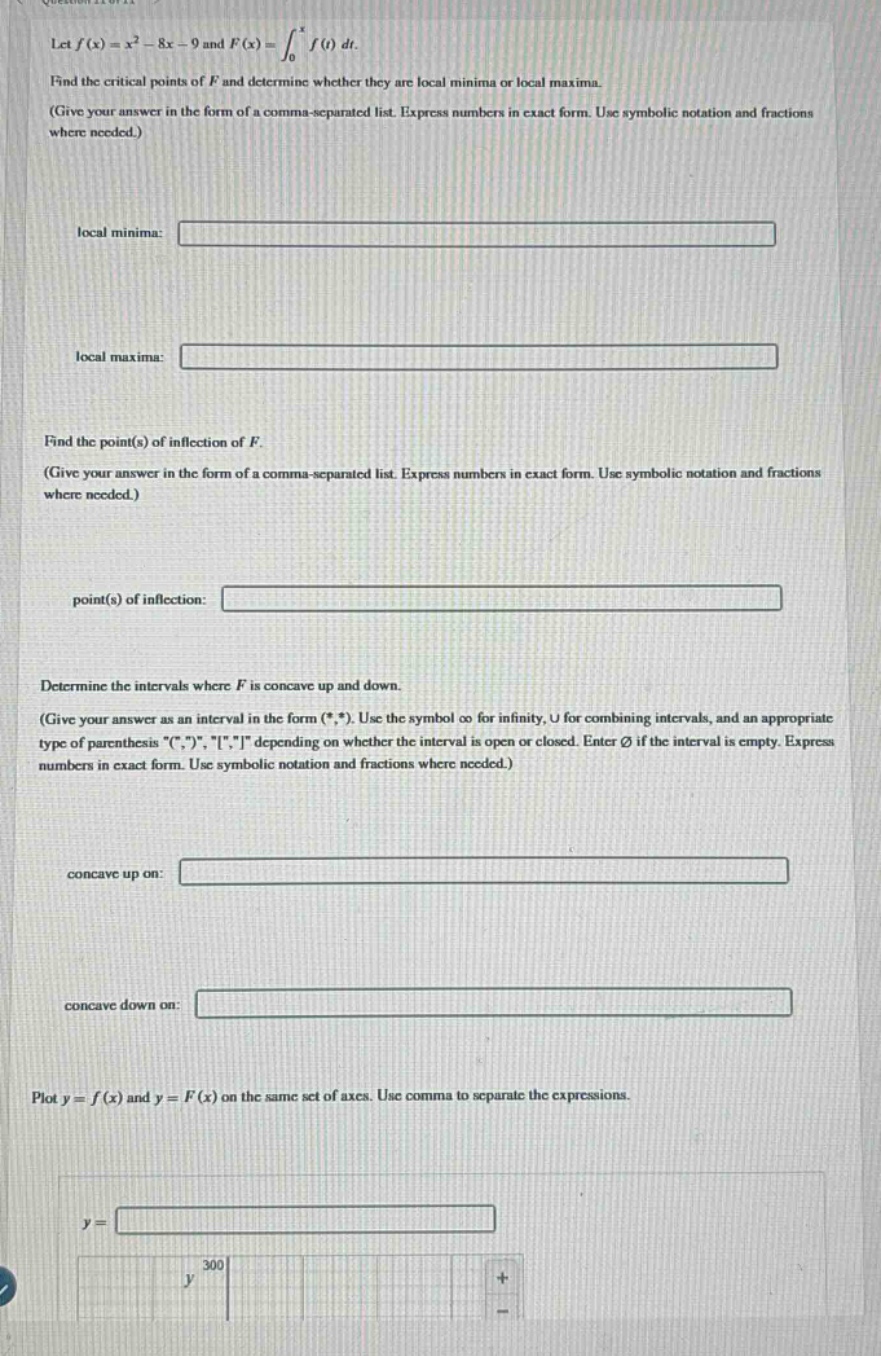
let f(x)=x² - 8x - 9 and f(x)=∫₀ˣ f(t)dt. find the critical points of f and determine whether they are local minima or local maxima. (give your answer in the form of a comma - separated list. express numbers in exact form. use symbolic notation and fractions where needed.) local minima: local maxima: find the point(s) of inflection of f. (give your answer in the form of a comma - separated list. express numbers in exact form. use symbolic notation and fractions where needed.) point(s) of inflection: determine the intervals where f is concave up and down. (give your answer as an interval in the form (*,*). use the symbol ∞ for infinity, u for combining intervals, and an appropriate type of parenthesis \(\,\)\,\\,\\ depending on whether the interval is open or closed. enter ∅ if the interval is empty. express numbers in exact form. use symbolic notation and fractions where needed.) concave up on: concave down on: plot y = f(x) and y = f(x) on the same set of axes. use comma to separate the expressions. y=
Answer
Explanation:
Step1: Find the derivative of (F(x))
By the fundamental - theorem of calculus, if (F(x)=\int_{0}^{x}f(t)dt), then (F^\prime(x)=f(x)=x^{2}-8x - 9).
Step2: Find the critical points of (F(x))
Set (F^\prime(x)=0), so (x^{2}-8x - 9 = 0). Factor the quadratic equation: ((x - 9)(x+1)=0). Solving for (x) gives (x=-1,9).
Step3: Find the second - derivative of (F(x))
Differentiate (F^\prime(x)=x^{2}-8x - 9) with respect to (x). Then (F^{\prime\prime}(x)=2x - 8).
Step4: Classify the critical points
Evaluate (F^{\prime\prime}(x)) at the critical points:
- When (x=-1), (F^{\prime\prime}(-1)=2(-1)-8=-10\lt0). So (x = - 1) is a local maximum.
- When (x = 9), (F^{\prime\prime}(9)=2\times9-8 = 10\gt0). So (x = 9) is a local minimum.
Step5: Find the points of inflection
Set (F^{\prime\prime}(x)=0), so (2x - 8=0). Solving for (x) gives (x = 4).
Step6: Determine the concavity intervals
- If (F^{\prime\prime}(x)=2x - 8\gt0), then (2x\gt8), (x\gt4). So (F(x)) is concave up on the interval ((4,\infty)).
- If (F^{\prime\prime}(x)=2x - 8\lt0), then (2x\lt8), (x\lt4). So (F(x)) is concave down on the interval ((-\infty,4)).
Answer:
local minima: (9) local maxima: (-1) point(s) of inflection: (4) concave up on: ((4,\infty)) concave down on: ((-\infty,4)) (y=x^{2}-8x - 9,\int_{0}^{x}(t^{2}-8t - 9)dt)