let f(x)=(x^4 - 8x^2)/5. a. use the definition of a derivative or the derivative rules to find: f(x)= b. use…
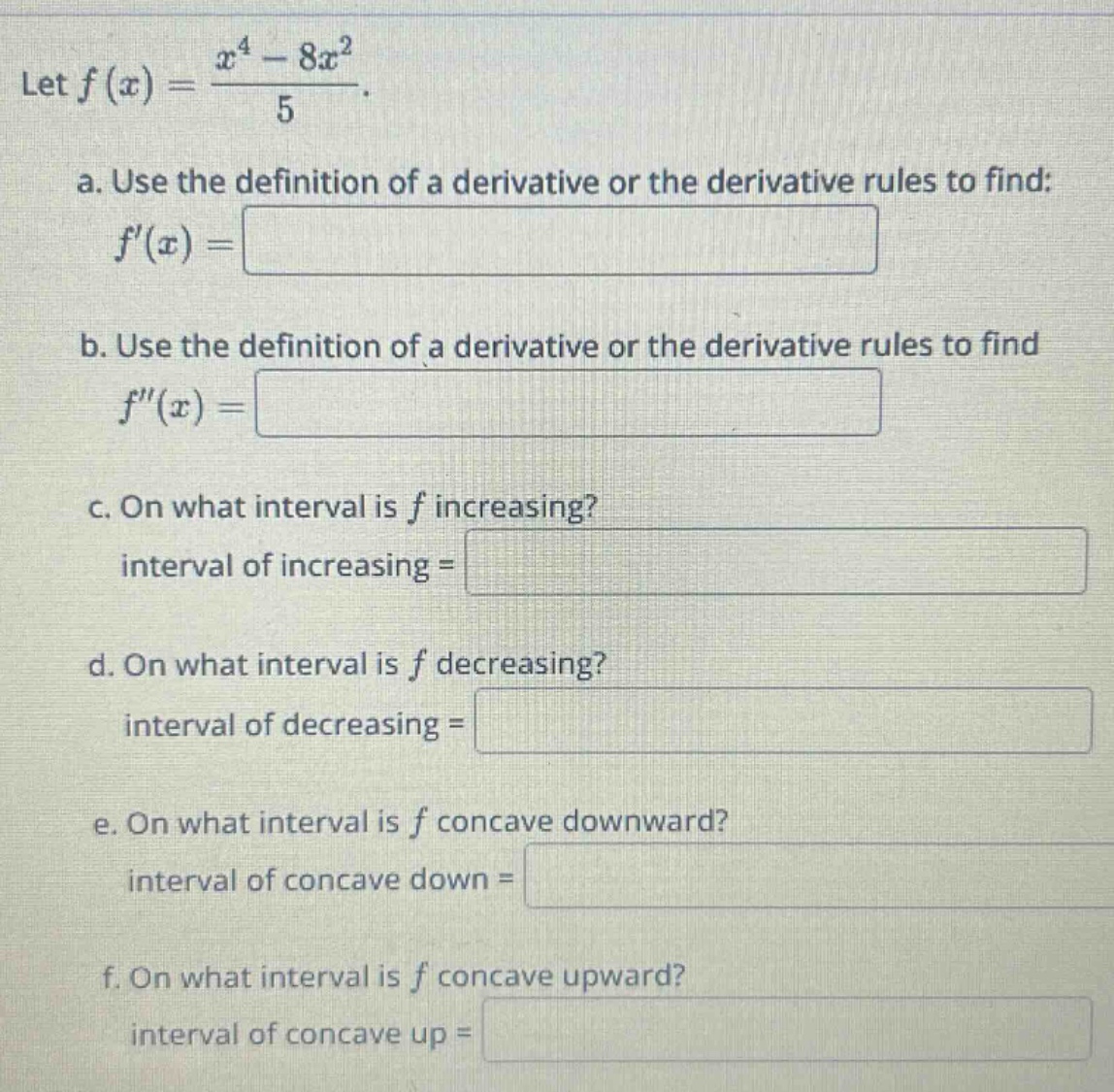
let f(x)=(x^4 - 8x^2)/5. a. use the definition of a derivative or the derivative rules to find: f(x)= b. use the definition of a derivative or the derivative rules to find f(x)= c. on what interval is f increasing? interval of increasing = d. on what interval is f decreasing? interval of decreasing = e. on what interval is f concave downward? interval of concave down = f. on what interval is f concave upward? interval of concave up =
Answer
Explanation:
Step1: Recall derivative rules
The derivative of a function $y = \frac{u}{v}$ (where $v$ is a non - zero constant) is $y'=\frac{u'}{v}$, and the power rule states that if $y = x^n$, then $y'=nx^{n - 1}$. Given $f(x)=\frac{x^{4}-8x^{2}}{5}=\frac{1}{5}x^{4}-\frac{8}{5}x^{2}$. The first - derivative $f'(x)$: [ \begin{align*} f'(x)&=\frac{1}{5}\times4x^{3}-\frac{8}{5}\times2x\ &=\frac{4}{5}x^{3}-\frac{16}{5}x\ &=\frac{4x(x^{2} - 4)}{5}\ &=\frac{4x(x - 2)(x + 2)}{5} \end{align*} ]
Step2: Find the second - derivative
Differentiate $f'(x)=\frac{4}{5}x^{3}-\frac{16}{5}x$ using the power rule. [ \begin{align*} f''(x)&=\frac{4}{5}\times3x^{2}-\frac{16}{5}\ &=\frac{12x^{2}-16}{5}\ &=\frac{4(3x^{2}-4)}{5} \end{align*} ]
Step3: Determine intervals of increase and decrease
Set $f'(x)=0$, so $\frac{4x(x - 2)(x + 2)}{5}=0$. The critical points are $x=-2,0,2$. Test the intervals $(-\infty,-2)$, $(-2,0)$, $(0,2)$ and $(2,\infty)$:
- For $x\in(-\infty,-2)$, let $x=-3$. Then $f'(-3)=\frac{4\times(-3)\times((-3)^{2}-4)}{5}=\frac{-12\times5}{5}=-12<0$, so $f(x)$ is decreasing on $(-\infty,-2)$.
- For $x\in(-2,0)$, let $x = - 1$. Then $f'(-1)=\frac{4\times(-1)\times((-1)^{2}-4)}{5}=\frac{-4\times(-3)}{5}=\frac{12}{5}>0$, so $f(x)$ is increasing on $(-2,0)$.
- For $x\in(0,2)$, let $x = 1$. Then $f'(1)=\frac{4\times1\times(1^{2}-4)}{5}=\frac{4\times(-3)}{5}=-\frac{12}{5}<0$, so $f(x)$ is decreasing on $(0,2)$.
- For $x\in(2,\infty)$, let $x = 3$. Then $f'(3)=\frac{4\times3\times(3^{2}-4)}{5}=\frac{12\times5}{5}=12>0$, so $f(x)$ is increasing on $(2,\infty)$.
Step4: Determine intervals of concavity
Set $f''(x)=0$, so $\frac{4(3x^{2}-4)}{5}=0$. Then $3x^{2}-4 = 0$, which gives $x=\pm\frac{2}{\sqrt{3}}=\pm\frac{2\sqrt{3}}{3}$. Test the intervals $(-\infty,-\frac{2\sqrt{3}}{3})$, $(-\frac{2\sqrt{3}}{3},\frac{2\sqrt{3}}{3})$ and $(\frac{2\sqrt{3}}{3},\infty)$:
- For $x\in(-\infty,-\frac{2\sqrt{3}}{3})$, let $x=-2$. Then $f''(-2)=\frac{12\times(-2)^{2}-16}{5}=\frac{48 - 16}{5}=\frac{32}{5}>0$, so $f(x)$ is concave up on $(-\infty,-\frac{2\sqrt{3}}{3})$.
- For $x\in(-\frac{2\sqrt{3}}{3},\frac{2\sqrt{3}}{3})$, let $x = 0$. Then $f''(0)=\frac{12\times0^{2}-16}{5}=-\frac{16}{5}<0$, so $f(x)$ is concave down on $(-\frac{2\sqrt{3}}{3},\frac{2\sqrt{3}}{3})$.
- For $x\in(\frac{2\sqrt{3}}{3},\infty)$, let $x = 2$. Then $f''(2)=\frac{12\times2^{2}-16}{5}=\frac{48 - 16}{5}=\frac{32}{5}>0$, so $f(x)$ is concave up on $(\frac{2\sqrt{3}}{3},\infty)$.
Answer:
a. $f'(x)=\frac{4}{5}x^{3}-\frac{16}{5}x$ b. $f''(x)=\frac{12x^{2}-16}{5}$ c. $(-2,0)\cup(2,\infty)$ d. $(-\infty,-2)\cup(0,2)$ e. $(-\frac{2\sqrt{3}}{3},\frac{2\sqrt{3}}{3})$ f. $(-\infty,-\frac{2\sqrt{3}}{3})\cup(\frac{2\sqrt{3}}{3},\infty)$