let f(x)=8x^4(x - 6)^2. (a) use interval notation to indicate where f(x) is increasing. note: use inf for ∞…
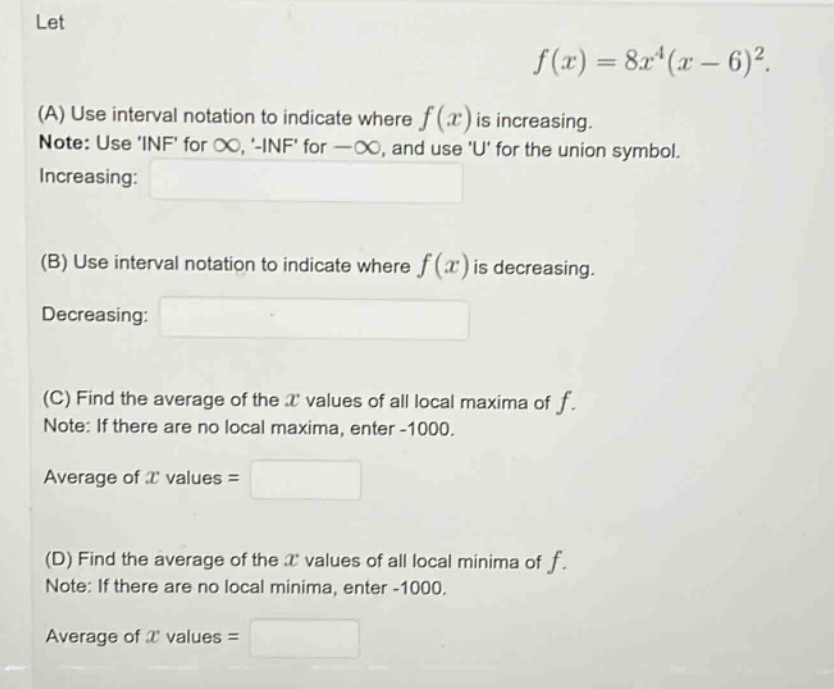
let f(x)=8x^4(x - 6)^2. (a) use interval notation to indicate where f(x) is increasing. note: use inf for ∞, -inf for -∞, and use u for the union symbol. increasing: (b) use interval notation to indicate where f(x) is decreasing. decreasing: (c) find the average of the x values of all local maxima of f. note: if there are no local maxima, enter -1000. average of x values = (d) find the average of the x values of all local minima of f. note: if there are no local minima, enter -1000. average of x values =
Answer
Explanation:
Step1: Find the derivative of $f(x)$
Use the product - rule $(uv)^\prime = u^\prime v+uv^\prime$, where $u = 8x^{4}$ and $v=(x - 6)^{2}=x^{2}-12x + 36$. $u^\prime=32x^{3}$ and $v^\prime = 2(x - 6)=2x-12$. $f^\prime(x)=32x^{3}(x - 6)^{2}+8x^{4}\times2(x - 6)$ $=8x^{3}(x - 6)[4(x - 6)+2x]$ $=8x^{3}(x - 6)(4x-24 + 2x)$ $=8x^{3}(x - 6)(6x-24)$ $=48x^{3}(x - 6)(x - 4)$.
Step2: Find the critical points
Set $f^\prime(x)=0$. $48x^{3}(x - 6)(x - 4)=0$. The critical points are $x = 0,x = 4,x = 6$.
Step3: Test the intervals
Choose test - points in the intervals $(-\infty,0),(0,4),(4,6),(6,\infty)$. For $x=-1$: $f^\prime(-1)=48\times(-1)^{3}\times(-1 - 6)\times(-1 - 4)=48\times(-1)\times(-7)\times(-5)<0$. For $x = 1$: $f^\prime(1)=48\times1^{3}\times(1 - 6)\times(1 - 4)=48\times1\times(-5)\times(-3)>0$. For $x = 5$: $f^\prime(5)=48\times5^{3}\times(5 - 6)\times(5 - 4)=48\times125\times(-1)\times1<0$. For $x = 7$: $f^\prime(7)=48\times7^{3}\times(7 - 6)\times(7 - 4)=48\times343\times1\times3>0$.
Step4: Determine increasing and decreasing intervals
(A) Increasing intervals: $(0,4)\cup(6,\infty)$. (B) Decreasing intervals: $(-\infty,0)\cup(4,6)$.
Step5: Identify local maxima and minima
Since $f(x)$ changes from decreasing to increasing at $x = 0$ and $x = 6$, these are local minima. Since $f(x)$ changes from increasing to decreasing at $x = 4$, this is a local maximum.
Step6: Calculate the averages
(C) The $x$ - value of the local maximum is $x = 4$, so the average of the $x$ - values of all local maxima is $4$. (D) The $x$ - values of the local minima are $x = 0$ and $x = 6$, and the average is $\frac{0 + 6}{2}=3$.
Answer:
(A) $(0,4)\cup(6,\infty)$ (B) $(-\infty,0)\cup(4,6)$ (C) $4$ (D) $3$