let h(x)=x³e⁻ˣ. what is the absolute maximum value of h? choose 1 answer: a -1/e³ b e³/3 c 27/e³ d h has no…
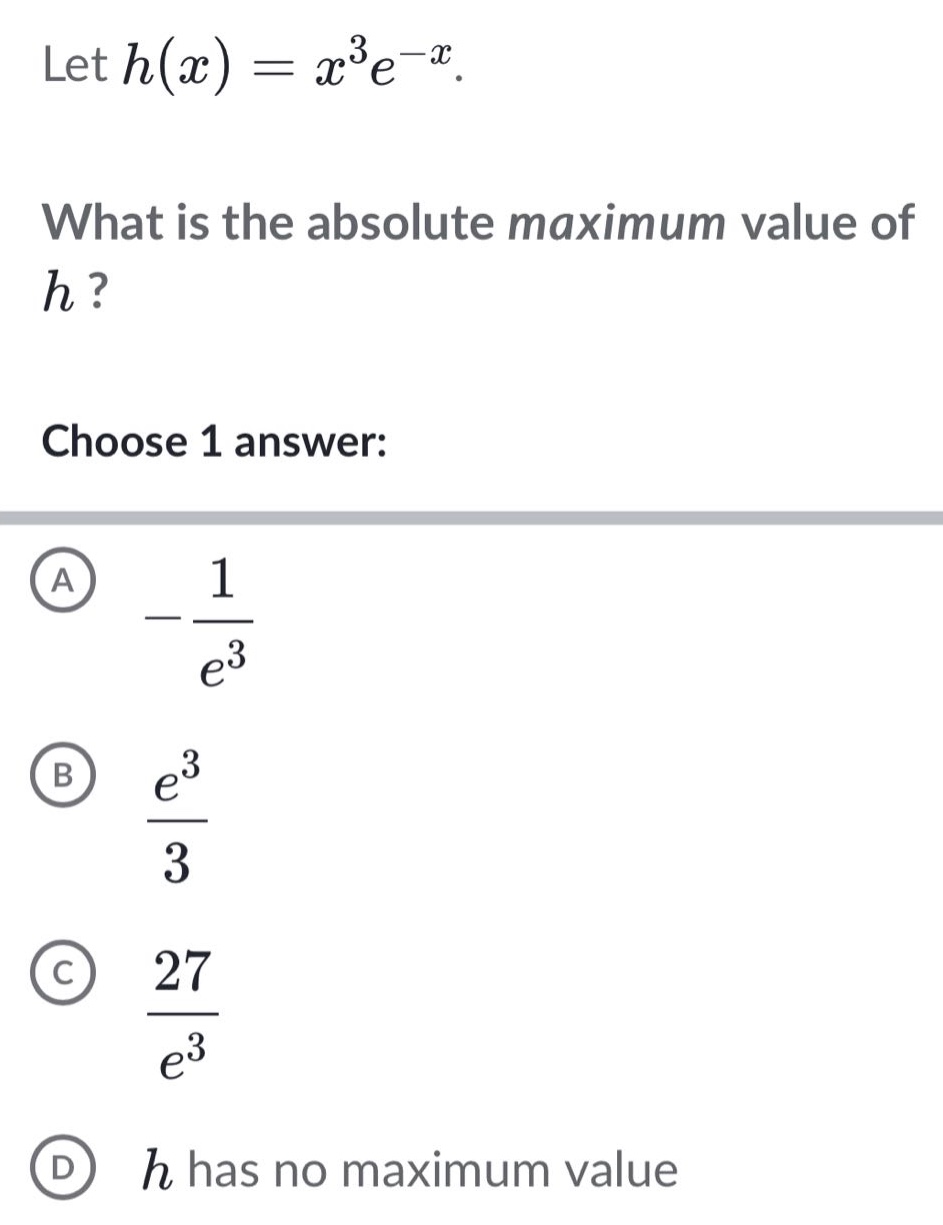
let h(x)=x³e⁻ˣ. what is the absolute maximum value of h? choose 1 answer: a -1/e³ b e³/3 c 27/e³ d h has no maximum value
Answer
Explanation:
Step1: Find the derivative of $h(x)$
Use the product - rule $(uv)^\prime = u^\prime v+uv^\prime$, where $u = x^{3}$ and $v = e^{-x}$. $u^\prime=3x^{2}$ and $v^\prime=-e^{-x}$. So $h^\prime(x)=3x^{2}e^{-x}-x^{3}e^{-x}=x^{2}e^{-x}(3 - x)$.
Step2: Find the critical points
Set $h^\prime(x) = 0$. Since $x^{2}e^{-x}(3 - x)=0$, and $e^{-x}>0$ for all real $x$, then $x^{2}(3 - x)=0$. The solutions are $x = 0$ and $x = 3$.
Step3: Analyze the sign of the derivative
When $x<3$ and $x\neq0$, $h^\prime(x)\geq0$ (positive when $x\in(0,3)$ and zero at $x = 0$). When $x>3$, $h^\prime(x)<0$. So the function $h(x)$ is increasing on $(-\infty,3)$ and decreasing on $(3,\infty)$.
Step4: Evaluate the function at the critical points
$h(0)=0^{3}\times e^{-0}=0$. $h(3)=3^{3}\times e^{-3}=\frac{27}{e^{3}}$.
Answer:
C. $\frac{27}{e^{3}}$