let f be a continuous function such that f changes from increasing to decreasing, and the graph of f changes…
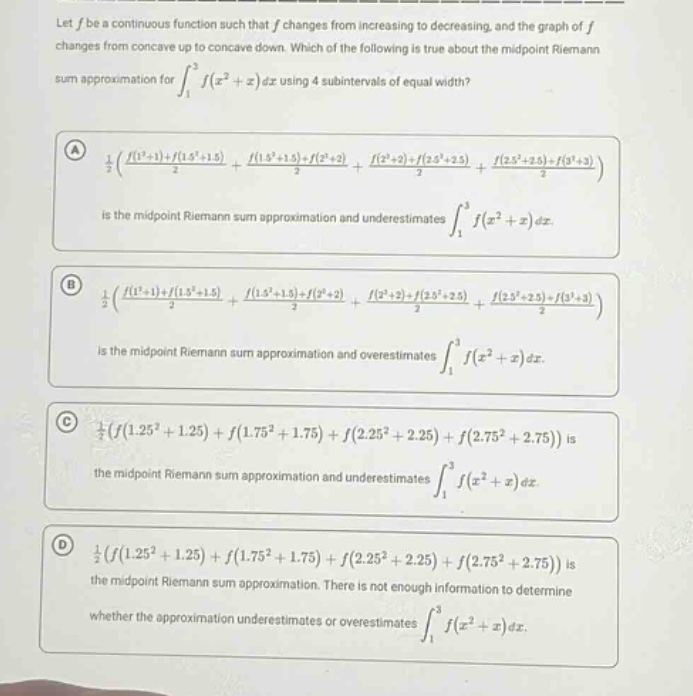
let f be a continuous function such that f changes from increasing to decreasing, and the graph of f changes from concave up to concave down. which of the following is true about the midpoint riemann sum approximation for ∫₁³ f(x² + x) dx using 4 subintervals of equal width? (a) 1/2((f(1²+1)+f(1.5²+1.5))/2 + (f(1.5²+1.5)+f(2²+2))/2 + (f(2²+2)+f(2.5²+2.5))/2 + (f(2.5²+2.5)+f(3²+3))/2) is the midpoint riemann sum approximation and underestimates ∫₁³ f(x² + x) dx. (b) 1/2((f(1²+1)+f(1.5²+1.5))/2 + (f(1.5²+1.5)+f(2²+2))/2 + (f(2²+2)+f(2.5²+2.5))/2 + (f(2.5²+2.5)+f(3²+3))/2) is the midpoint riemann sum approximation and overestimates ∫₁³ f(x² + x) dx. (c) 1/2(f(1.25² + 1.25) + f(1.75² + 1.75) + f(2.25² + 2.25) + f(2.75² + 2.75)) is the midpoint riemann sum approximation and underestimates ∫₁³ f(x² + x) dx. (d) 1/2(f(1.25² + 1.25) + f(1.75² + 1.75) + f(2.25² + 2.25) + f(2.75² + 2.75)) is the midpoint riemann sum approximation. there is not enough information to determine whether the approximation underestimates or overestimates ∫₁³ f(x² + x) dx.
Answer
Explanation:
Step1: Recall mid - point Riemann sum formula
For $\int_{a}^{b}g(x)dx$ with $n$ sub - intervals of equal width $\Delta x=\frac{b - a}{n}$, the mid - point Riemann sum $M_n=\sum_{i = 1}^{n}g(x_i^)\Delta x$, where $x_i^$ is the mid - point of the $i$th sub - interval. Here, $a = 1$, $b = 3$, $n=4$, so $\Delta x=\frac{3 - 1}{4}=0.5$. The sub - intervals are $[1,1.5]$, $[1.5,2]$, $[2,2.5]$, $[2.5,3]$, and the mid - points are $x_1^=1.25$, $x_2^=1.75$, $x_3^=2.25$, $x_4^=2.75$. The mid - point Riemann sum for $\int_{1}^{3}f(x^{2}+x)dx$ is $M_4=\frac{1}{2}(f(1.25^{2}+1.25)+f(1.75^{2}+1.75)+f(2.25^{2}+2.25)+f(2.75^{2}+2.75))$.
Step2: Analyze concavity and increasing - decreasing behavior
Since $f$ changes from increasing to decreasing and from concave up to concave down, we cannot determine whether the mid - point Riemann sum overestimates or underestimates the integral. When a function is concave up, the mid - point Riemann sum underestimates the integral, and when it is concave down, the mid - point Riemann sum overestimates the integral. Since $f$ has mixed concavity and increasing - decreasing behavior, there is not enough information to determine the relationship between the mid - point Riemann sum and the actual value of the integral.
Answer:
D. $\frac{1}{2}(f(1.25^{2}+1.25)+f(1.75^{2}+1.75)+f(2.25^{2}+2.25)+f(2.75^{2}+2.75))$ is the mid - point Riemann sum approximation. There is not enough information to determine whether the approximation underestimates or overestimates $\int_{1}^{3}f(x^{2}+x)dx$.