let h(x)=√(x² + 4)\nwhere does h have critical points?\nchoose all answers that apply:\na x = -2\nb x = 0\nc…
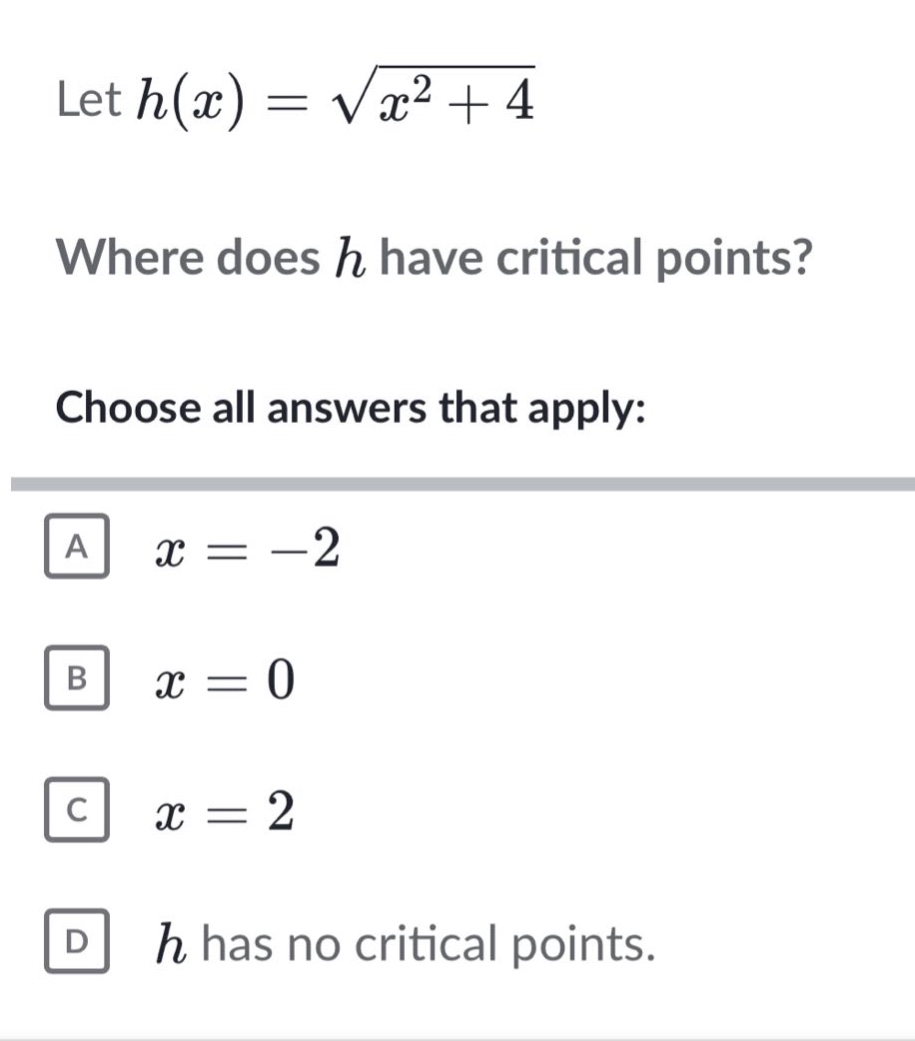
let h(x)=√(x² + 4)\nwhere does h have critical points?\nchoose all answers that apply:\na x = -2\nb x = 0\nc x = 2\nd h has no critical points.
Answer
Explanation:
Step1: Find the derivative of $h(x)$
Use the chain - rule. Let $u = x^{2}+4$, then $h(x)=\sqrt{u}=u^{\frac{1}{2}}$. The derivative of $u$ with respect to $x$ is $u^\prime = 2x$, and the derivative of $h(u)$ with respect to $u$ is $h^\prime(u)=\frac{1}{2}u^{-\frac{1}{2}}$. By the chain - rule $h^\prime(x)=\frac{1}{2}(x^{2}+4)^{-\frac{1}{2}}\cdot2x=\frac{x}{\sqrt{x^{2}+4}}$.
Step2: Set the derivative equal to zero or find where it's undefined
The derivative $h^\prime(x)=\frac{x}{\sqrt{x^{2}+4}}$ is undefined when the denominator $\sqrt{x^{2}+4}=0$. But $x^{2}+4\geq4$ for all real $x$, so the denominator is never zero. Set the numerator equal to zero: $x = 0$. When $x = 0$, $h^\prime(x)=0$.
Answer:
B. $x = 0$