let a(x)=∫₀ˣ f(t) dt, with y = f(x) as in the figure. does a have a local maximum at p? yes, because f…
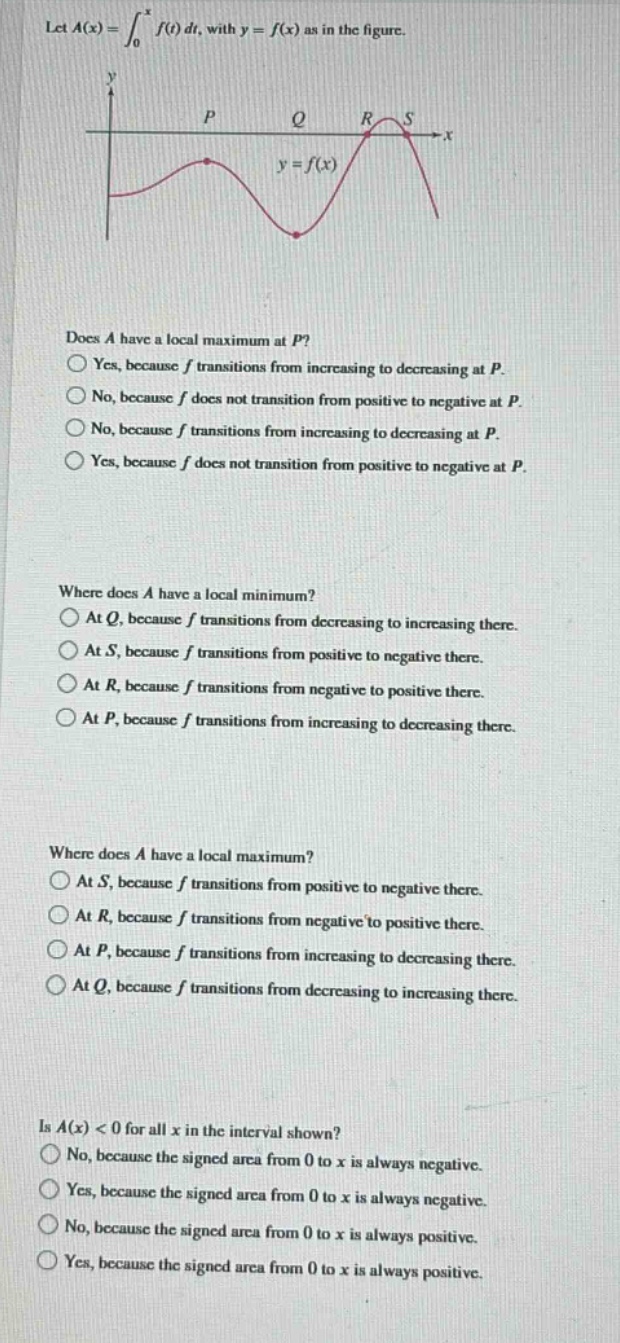
let a(x)=∫₀ˣ f(t) dt, with y = f(x) as in the figure. does a have a local maximum at p? yes, because f transitions from increasing to decreasing at p. no, because f does not transition from positive to negative at p. no, because f transitions from increasing to decreasing at p. yes, because f does not transition from positive to negative at p. where does a have a local minimum? at q, because f transitions from decreasing to increasing there. at s, because f transitions from positive to negative there. at r, because f transitions from negative to positive there. at p, because f transitions from increasing to decreasing there. where does a have a local maximum? at s, because f transitions from positive to negative there. at r, because f transitions from negative to positive there. at p, because f transitions from increasing to decreasing there. at q, because f transitions from decreasing to increasing there. is a(x) < 0 for all x in the interval shown? no, because the signed area from 0 to x is always negative. yes, because the signed area from 0 to x is always negative. no, because the signed area from 0 to x is always positive. yes, because the signed area from 0 to x is always positive.
Answer
Explanation:
Step1: Recall the fundamental theorem of calculus
If $A(x)=\int_{0}^{x}f(t)dt$, then $A^\prime(x) = f(x)$. A local - maximum of $A(x)$ occurs where $A^\prime(x)=f(x)$ changes sign from positive to negative, and a local - minimum of $A(x)$ occurs where $A^\prime(x)=f(x)$ changes sign from negative to positive.
Step2: Analyze the first question
At point $P$, the function $y = f(x)$ changes from increasing to decreasing, but for $A(x)$ to have a local maximum, $f(x)$ must change from positive to negative. Since $f(x)$ does not change from positive to negative at $P$, the answer is no.
Step3: Analyze the second question
A local minimum of $A(x)$ occurs where $f(x)$ changes sign from negative to positive. At point $R$, $f(x)$ changes from negative to positive. So $A(x)$ has a local minimum at $R$.
Step4: Analyze the third question
A local maximum of $A(x)$ occurs where $f(x)$ changes sign from positive to negative. At point $S$, $f(x)$ changes from positive to negative. So $A(x)$ has a local maximum at $S$.
Step5: Analyze the fourth question
The function $A(x)=\int_{0}^{x}f(t)dt$ represents the signed - area between the curve $y = f(t)$ and the $t$ - axis from $t = 0$ to $t=x$. Looking at the graph, the signed area is not always negative. For example, in some parts of the interval, the area above the $x$ - axis (positive contribution) and below the $x$ - axis (negative contribution) will cancel out or result in a non - negative value. So $A(x)$ is not less than 0 for all $x$ in the interval shown.
Answer:
- No, because $f$ does not transition from positive to negative at $P$.
- At $R$, because $f$ transitions from negative to positive there.
- At $S$, because $f$ transitions from positive to negative there.
- No, because the signed area from $0$ to $x$ is not always negative.