let g(x) = ∫₀ˣ f(t)dt, where the graph of f is shown below. for what value(s) of x does g have a relative…
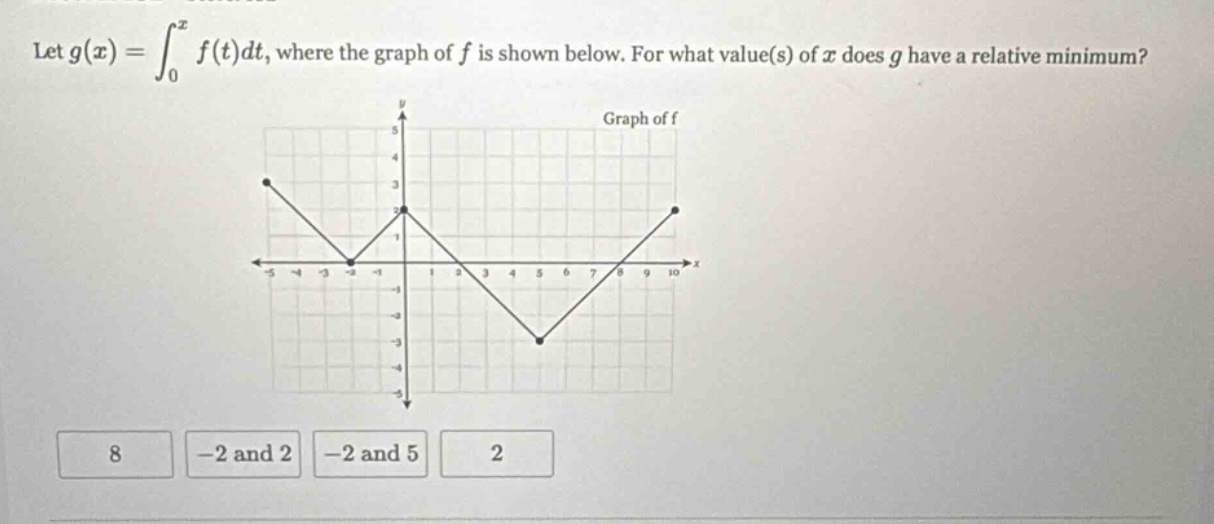
let g(x) = ∫₀ˣ f(t)dt, where the graph of f is shown below. for what value(s) of x does g have a relative minimum? 8 -2 and 2 -2 and 5 2
Answer
Answer:
-2 and 5
Explanation:
Step1: Recall the fundamental theorem of calculus
By the fundamental - theorem of calculus, $g^\prime(x)=f(x)$.
Step2: Use the first - derivative test for relative extrema
A function $g(x)$ has a relative minimum at a point $c$ if $g^\prime(x)$ changes sign from negative to positive at $x = c$.
Step3: Analyze the sign of $f(x)$
Looking at the graph of $f(x)$:
- $f(x)<0$ for $- 5<x<-2$ and $2 < x<5$.
- $f(x)>0$ for $-2<x<2$ and $5<x<10$.
- At $x=-2$, $f(x)$ changes sign from negative to positive.
- At $x = 5$, $f(x)$ changes sign from negative to positive. So $g(x)$ has relative minima at $x=-2$ and $x = 5$.