let f(x)={x - 2 if x<4; 2 if 4≤x≤6; x + 2 if x>6. a. find lim f(x) as x→4. b. find lim f(x) as x→6. select…
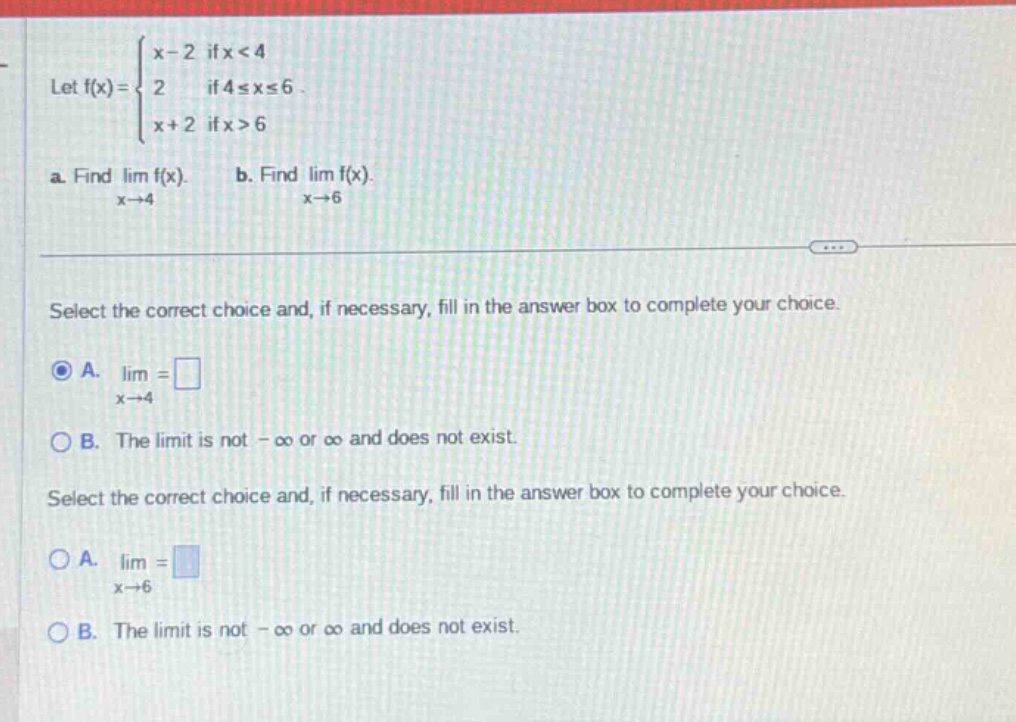
let f(x)={x - 2 if x<4; 2 if 4≤x≤6; x + 2 if x>6. a. find lim f(x) as x→4. b. find lim f(x) as x→6. select the correct choice and, if necessary, fill in the answer box to complete your choice. a. lim as x→4 = b. the limit is not -∞ or ∞ and does not exist. select the correct choice and, if necessary, fill in the answer box to complete your choice. a. lim as x→6 = b. the limit is not -∞ or ∞ and does not exist.
Answer
Explanation:
Step1: Find left - hand limit as x→4
For $x < 4$, $f(x)=x - 2$. So, $\lim_{x\rightarrow4^{-}}f(x)=\lim_{x\rightarrow4^{-}}(x - 2)=4-2 = 2$.
Step2: Find right - hand limit as x→4
For $x\geq4$, when approaching 4 from the right, $f(x) = 2$. So, $\lim_{x\rightarrow4^{+}}f(x)=2$. Since $\lim_{x\rightarrow4^{-}}f(x)=\lim_{x\rightarrow4^{+}}f(x)=2$, $\lim_{x\rightarrow4}f(x)=2$.
Step3: Find left - hand limit as x→6
For $x\leq6$, when approaching 6 from the left, $f(x)=2$. So, $\lim_{x\rightarrow6^{-}}f(x)=2$.
Step4: Find right - hand limit as x→6
For $x>6$, $f(x)=x + 2$. So, $\lim_{x\rightarrow6^{+}}f(x)=\lim_{x\rightarrow6^{+}}(x + 2)=6 + 2=8$. Since $\lim_{x\rightarrow6^{-}}f(x)\neq\lim_{x\rightarrow6^{+}}f(x)$, $\lim_{x\rightarrow6}f(x)$ does not exist.
Answer:
a. A. $\lim_{x\rightarrow4}=2$ b. B. The limit is not $-\infty$ or $\infty$ and does not exist.