let f be the function defined by f(x) = (2x + 3)/(x + 1). which of the following statements are true? i. the…
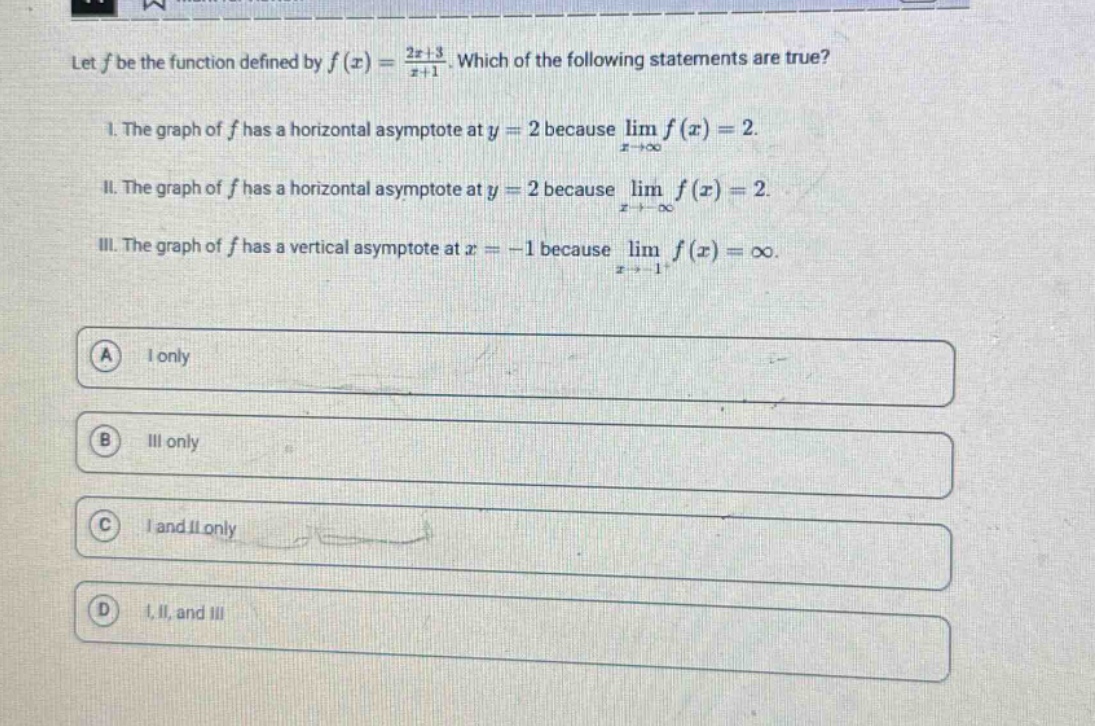
let f be the function defined by f(x) = (2x + 3)/(x + 1). which of the following statements are true? i. the graph of f has a horizontal asymptote at y = 2 because lim(x→+∞) f(x) = 2. ii. the graph of f has a horizontal asymptote at y = 2 because lim(x→ - ∞) f(x) = 2. iii. the graph of f has a vertical asymptote at x = - 1 because lim(x→ - 1⁺) f(x) = ∞. a i only b iii only c i and ii only d i, ii, and iii
Answer
Explanation:
Step1: Find $\lim_{x\rightarrow+\infty}f(x)$
Divide numerator and denominator by $x$: $\lim_{x\rightarrow+\infty}\frac{2x + 3}{x+1}=\lim_{x\rightarrow+\infty}\frac{2+\frac{3}{x}}{1+\frac{1}{x}}$. As $x\rightarrow+\infty$, $\frac{3}{x}\rightarrow0$ and $\frac{1}{x}\rightarrow0$. So $\lim_{x\rightarrow+\infty}\frac{2+\frac{3}{x}}{1+\frac{1}{x}} = 2$.
Step2: Find $\lim_{x\rightarrow-\infty}f(x)$
Again, divide numerator and denominator by $x$: $\lim_{x\rightarrow-\infty}\frac{2x + 3}{x+1}=\lim_{x\rightarrow-\infty}\frac{2+\frac{3}{x}}{1+\frac{1}{x}}$. As $x\rightarrow-\infty$, $\frac{3}{x}\rightarrow0$ and $\frac{1}{x}\rightarrow0$. So $\lim_{x\rightarrow-\infty}\frac{2+\frac{3}{x}}{1+\frac{1}{x}}=2$. This means $y = 2$ is a horizontal - asymptote.
Step3: Find $\lim_{x\rightarrow - 1^{+}}f(x)$
As $x\rightarrow - 1^{+}$, the numerator $2x + 3\rightarrow2\times(-1)+3=1$ and the denominator $x + 1\rightarrow0^{+}$. So $\lim_{x\rightarrow - 1^{+}}\frac{2x + 3}{x + 1}=\infty$. This means $x=-1$ is a vertical asymptote.
Answer:
D. I, II, and III