let f be the function defined above. which of the following statements is true? a f is continuous at x = 1…
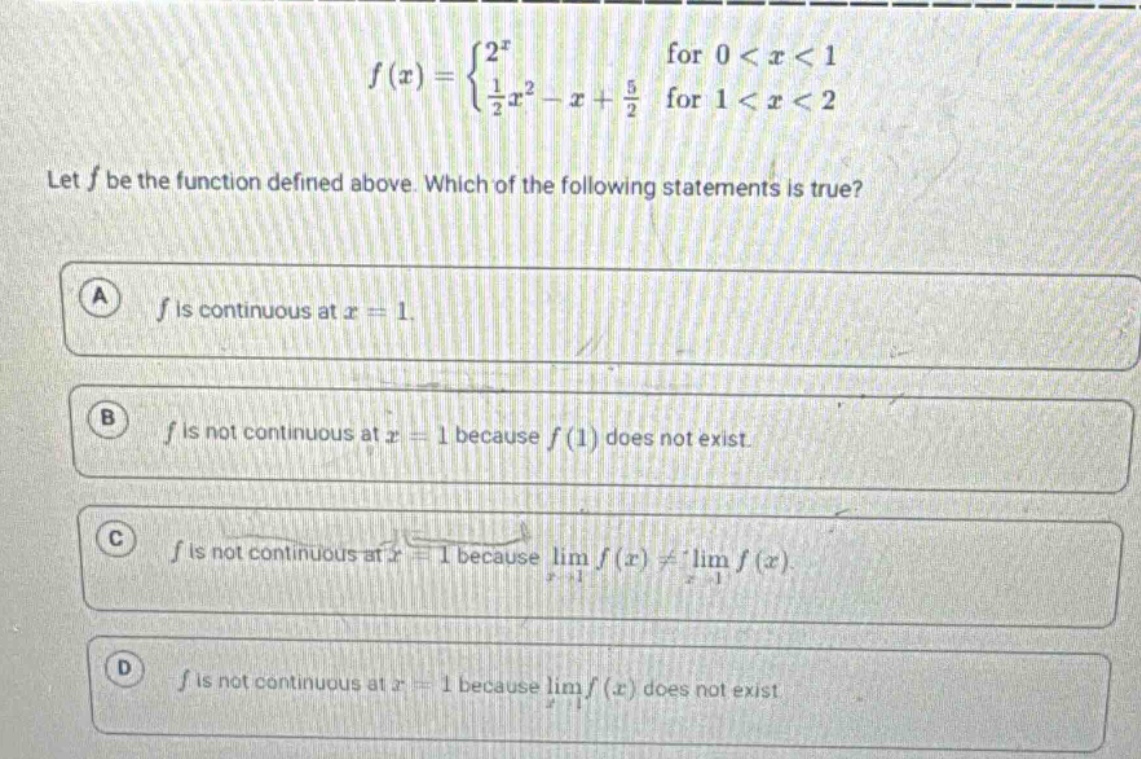
let f be the function defined above. which of the following statements is true? a f is continuous at x = 1. b f is not continuous at x = 1 because f(1) does not exist. c f is not continuous at x = 1 because lim f(x) ≠ lim f(x). d f is not continuous at x = 1 because lim f(x) does not exist
Answer
Explanation:
Step1: Find the left - hand limit
We find $\lim_{x\rightarrow1^{-}}f(x)$. Since for $0 < x<1$, $f(x)=2^{x}$, then $\lim_{x\rightarrow1^{-}}f(x)=\lim_{x\rightarrow1^{-}}2^{x}=2^{1} = 2$.
Step2: Find the right - hand limit
We find $\lim_{x\rightarrow1^{+}}f(x)$. Since for $1 < x<2$, $f(x)=\frac{1}{2}x^{2}-x+\frac{5}{2}$, then $\lim_{x\rightarrow1^{+}}f(x)=\frac{1}{2}(1)^{2}-1+\frac{5}{2}=\frac{1 - 2+5}{2}=2$.
Step3: Check the value of the function at the point
The function $f(x)$ is not defined at $x = 1$ because the domain of the first - part is $0<x<1$ and the domain of the second - part is $1<x<2$. For a function to be continuous at $x=a$, $\lim_{x\rightarrow a^{-}}f(x)=\lim_{x\rightarrow a^{+}}f(x)=f(a)$. Here, $f(1)$ does not exist.
Answer:
B. $f$ is not continuous at $x = 1$ because $f(1)$ does not exist.