let f be the function defined above. for what value of c, if any, is f continuous at x = 3?\na 2\nb 4\nc…
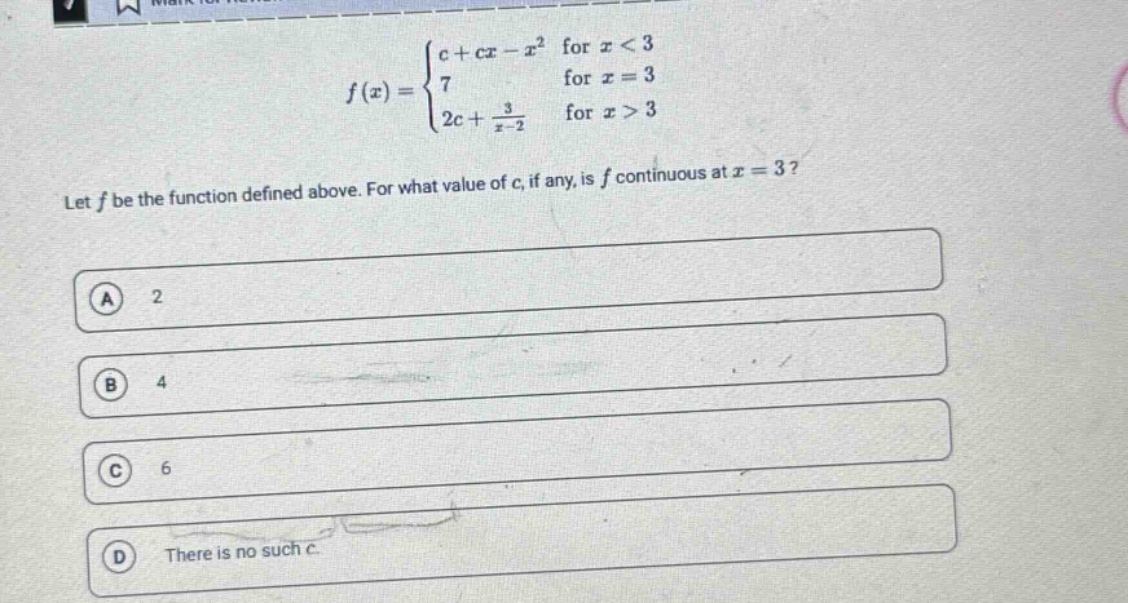
let f be the function defined above. for what value of c, if any, is f continuous at x = 3?\na 2\nb 4\nc 6\nd there is no such c.\nf(x) = {c + cx - x^2 for x < 3; 7 for x = 3; 2c + 3/(x - 2) for x > 3}
Answer
Explanation:
Step1: Recall continuity condition
For a function to be continuous at $x = a$, $\lim_{x\rightarrow a^{-}}f(x)=\lim_{x\rightarrow a^{+}}f(x)=f(a)$. Here $a = 3$, $f(3)=7$.
Step2: Calculate left - hand limit
$\lim_{x\rightarrow 3^{-}}f(x)=\lim_{x\rightarrow 3^{-}}(c + cx-x^{2})=c + 3c-9=4c - 9$.
Step3: Calculate right - hand limit
$\lim_{x\rightarrow 3^{+}}f(x)=\lim_{x\rightarrow 3^{+}}(2c+\frac{3}{x - 2})=2c+3$.
Step4: Set up equations
Since $\lim_{x\rightarrow 3^{-}}f(x)=\lim_{x\rightarrow 3^{+}}f(x)=f(3)$, we first set $\lim_{x\rightarrow 3^{-}}f(x)=f(3)$: $4c-9 = 7$, which gives $4c=16$, so $c = 4$. Then check with right - hand limit. Substitute $c = 4$ into $\lim_{x\rightarrow 3^{+}}f(x)=2c + 3$, we get $2\times4+3=11\neq7$. Then set $\lim_{x\rightarrow 3^{+}}f(x)=f(3)$: $2c+3=7$, which gives $2c=4$, so $c = 2$. Substitute $c = 2$ into $\lim_{x\rightarrow 3^{-}}f(x)=4c-9$, we get $4\times2-9=-1\neq7$.
Answer:
D. There is no such c.