let f(x) be a function that is differentiable on the entire real line. if f(-8)=-3 and f(10)=2, we can…
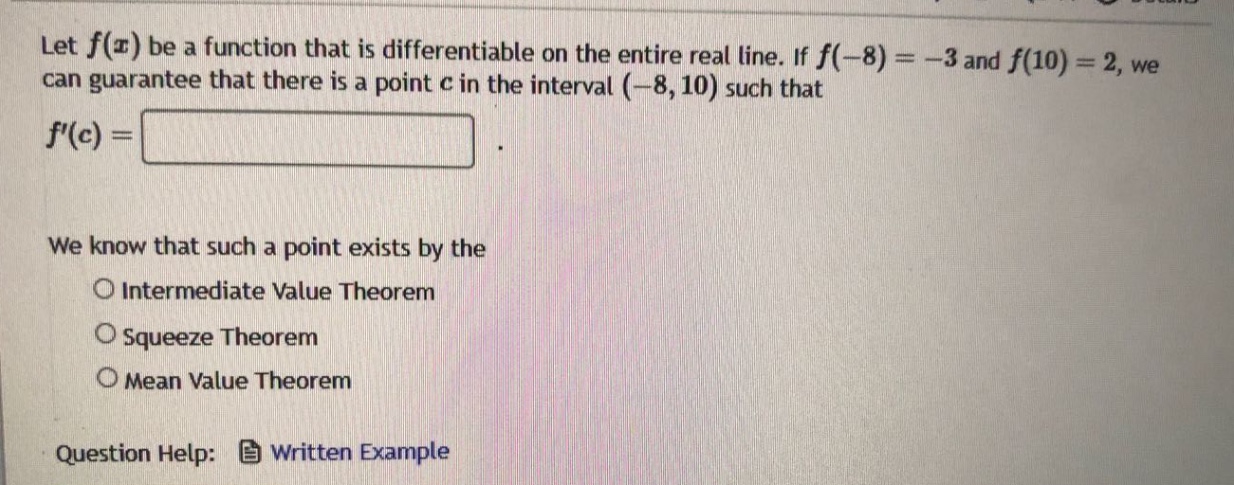
let f(x) be a function that is differentiable on the entire real line. if f(-8)=-3 and f(10)=2, we can guarantee that there is a point c in the interval (-8,10) such that f(c)=. we know that such a point exists by the intermediate value theorem squeeze theorem mean value theorem question help: written example
Answer
Explanation:
Step1: Recall Mean - Value Theorem formula
The Mean - Value Theorem states that if (y = f(x)) is continuous on the closed interval ([a,b]) and differentiable on the open interval ((a,b)), then (f^{\prime}(c)=\frac{f(b)-f(a)}{b - a}) for some (c\in(a,b)). Here (a=-8), (b = 10), (f(a)=-3) and (f(b)=2).
Step2: Calculate (f^{\prime}(c))
Substitute the values into the formula (f^{\prime}(c)=\frac{f(10)-f(-8)}{10-(-8)}). Then (f^{\prime}(c)=\frac{2-(-3)}{10 + 8}=\frac{2 + 3}{18}=\frac{5}{18}). The point (c) exists by the Mean - Value Theorem because the function (f(x)) is differentiable on the entire real - line, so it is continuous on ([-8,10]) and differentiable on ((-8,10)).
Answer:
(\frac{5}{18}), Mean Value Theorem