let f be a function such that f(1)= -2 and f(5)=7. which of the following conditions ensures that f(c)=0 for…
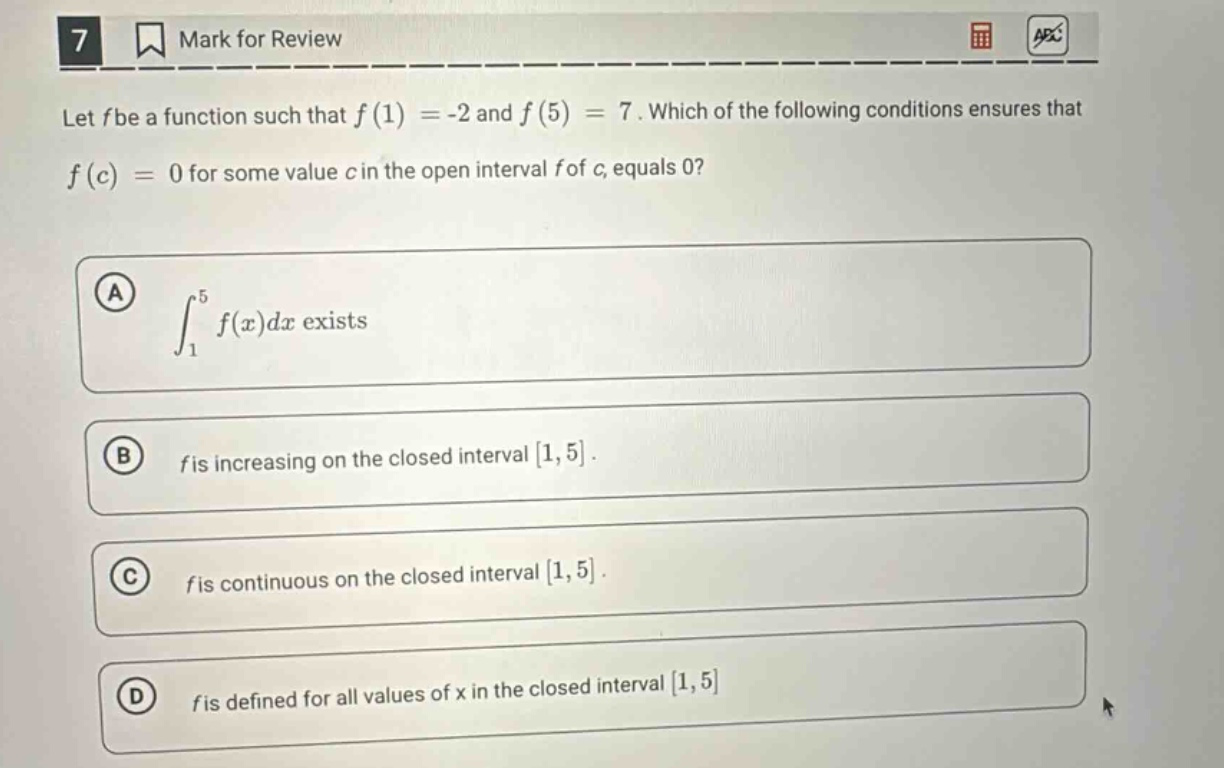
let f be a function such that f(1)= -2 and f(5)=7. which of the following conditions ensures that f(c)=0 for some value c in the open interval f of c, equals 0? a ∫₁⁵f(x)dx exists b f is increasing on the closed interval 1,5. c f is continuous on the closed interval 1,5. d f is defined for all values of x in the closed interval 1,5
Answer
Explanation:
Step1: Recall Intermediate - Value Theorem
The Intermediate - Value Theorem states that if a function (y = f(x)) is continuous on a closed interval ([a,b]), and (k) is a number between (f(a)) and (f(b)), then there exists at least one number (c) in the open interval ((a,b)) such that (f(c)=k). Here, (a = 1), (b = 5), (f(1)=-2), (f(5)=7), and (k = 0) (since ( - 2<0<7)).
Step2: Analyze each option
- Option A: The existence of (\int_{1}^{5}f(x)dx) does not guarantee that (f(c)=0) for some (c\in(1,5)). A non - continuous function can also be integrable.
- Option B: Just because (f) is increasing on ([1,5]) does not ensure (f(c)=0) in ((1,5)) without continuity. For example, a non - continuous increasing function may skip the value (0).
- Option C: Since (f) is continuous on ([1,5]), and (0) is between (f(1)=-2) and (f(5)=7), by the Intermediate - Value Theorem, there exists a (c\in(1,5)) such that (f(c)=0).
- Option D: A function can be defined on ([1,5]) but not continuous, and thus may not take the value (0) in ((1,5)).
Answer:
C. (f) is continuous on the closed interval ([1,5])