let f be the function given by f(x) = (e^2x - 1)/x. which of the following equations expresses the property…
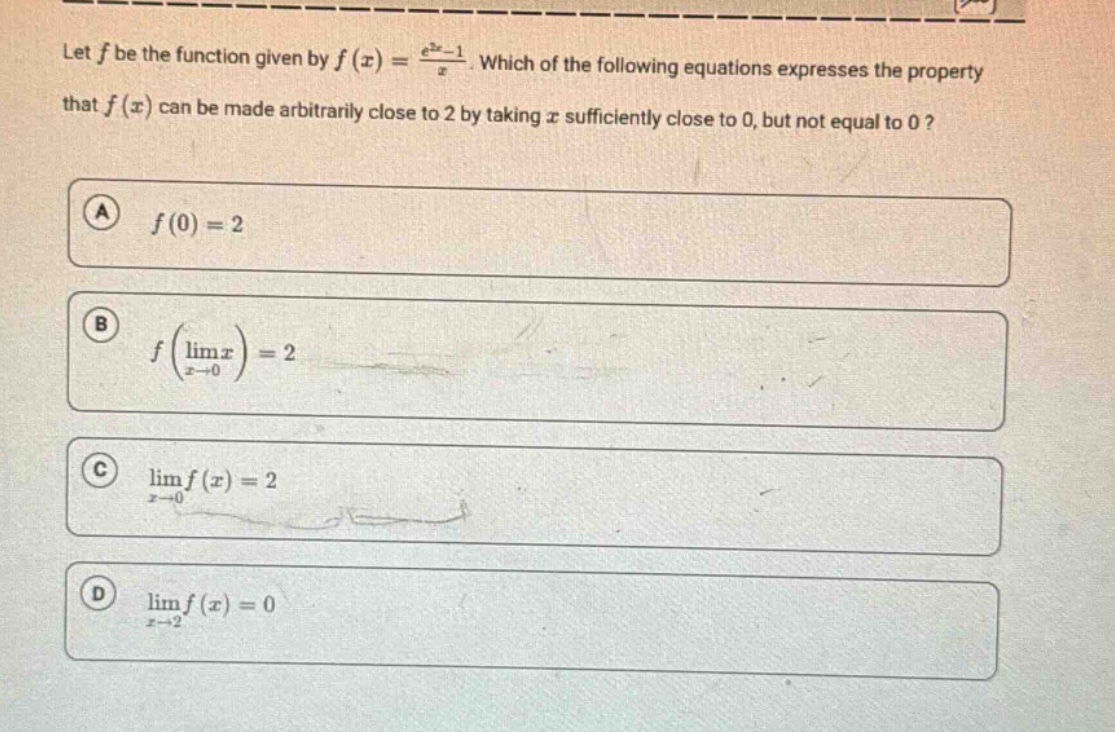
let f be the function given by f(x) = (e^2x - 1)/x. which of the following equations expresses the property that f(x) can be made arbitrarily close to 2 by taking x sufficiently close to 0, but not equal to 0? a f(0)=2 b f(lim x→0 x)=2 c lim x→0 f(x)=2 d lim x→2 f(x)=0
Answer
Explanation:
Step1: Recall limit definition
The statement "a function $f(x)$ can be made arbitrarily close to a value $L$ by taking $x$ sufficiently close to $a$, but not equal to $a$" is the informal definition of the limit $\lim_{x\rightarrow a}f(x)=L$. Here $a = 0$ and $L = 2$.
Step2: Analyze each option
- Option A: $f(0)=2$ is the value of the function at $x = 0$. But the function $f(x)=\frac{e^{2x}-1}{x}$ is not defined at $x = 0$.
- Option B: $f(\lim_{x\rightarrow0}x)$ is an incorrect notation. First, $\lim_{x\rightarrow0}x = 0$, and then we would be trying to evaluate $f(0)$ which is not defined for $f(x)=\frac{e^{2x}-1}{x}$.
- Option C: $\lim_{x\rightarrow0}f(x)=2$ correctly represents that as $x$ approaches $0$ (but $x\neq0$), the function $f(x)$ approaches $2$.
- Option D: $\lim_{x\rightarrow2}f(x)=0$ has the wrong value for the limit and the wrong - approaching value of $x$.
Answer:
C. $\lim_{x\rightarrow0}f(x)=2$