let f be the function given by f(x)=2^x. selected values of f are given in the table above. if the values in…
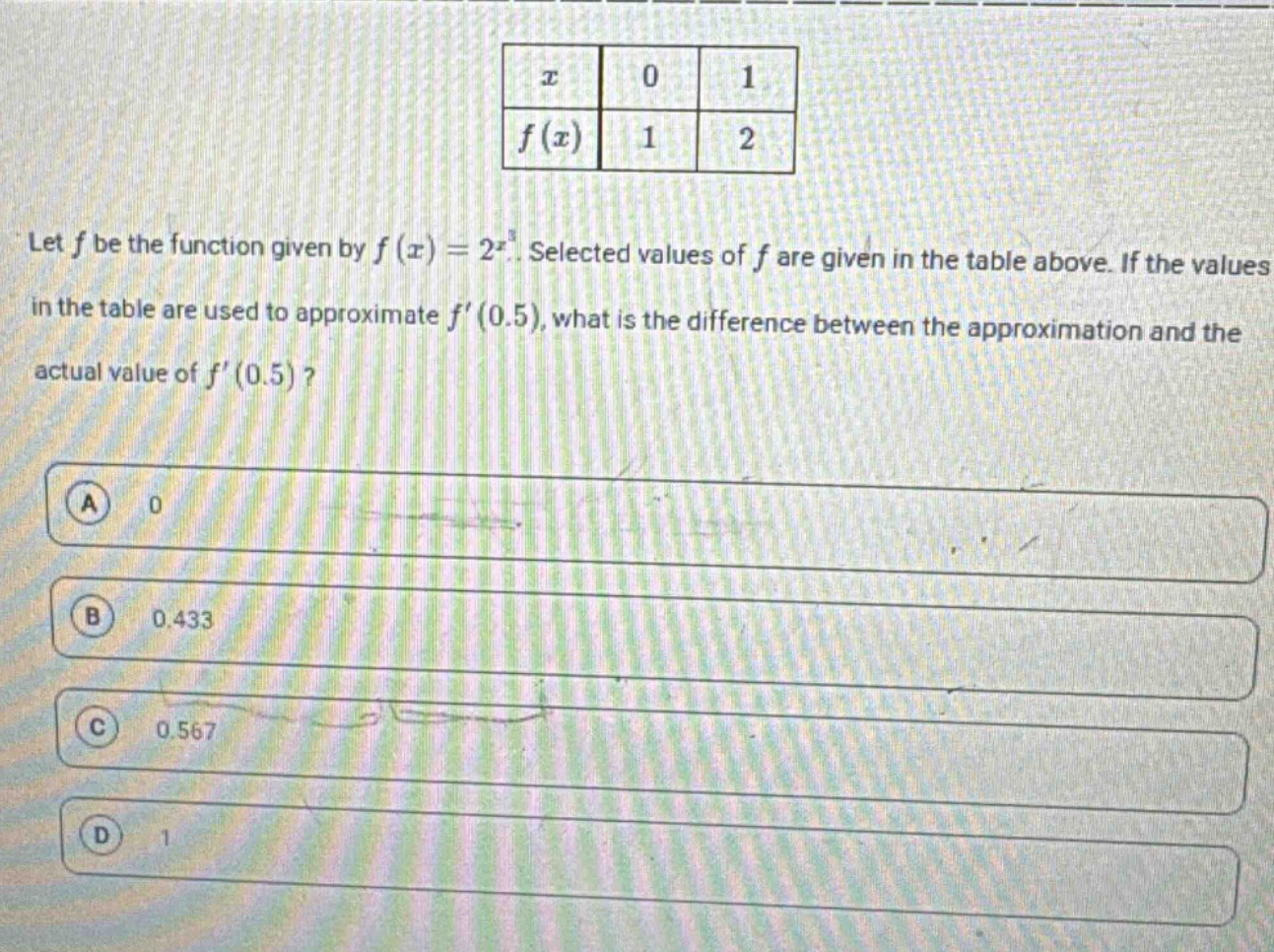
let f be the function given by f(x)=2^x. selected values of f are given in the table above. if the values in the table are used to approximate f(0.5), what is the difference between the approximation and the actual value of f(0.5)? a 0 b 0.433 c 0.567 d 1
Answer
Explanation:
Step1: Find the approximation of $f^{\prime}(0.5)$
Use the symmetric - difference quotient. The symmetric - difference quotient for approximating $f^{\prime}(a)$ is $\frac{f(a + h)-f(a - h)}{2h}$. Here, with $a = 0.5$, and using the points $x = 0$ and $x = 1$ (so $h=0.5$), the approximation of $f^{\prime}(0.5)$ is $\frac{f(1)-f(0)}{1 - 0}=\frac{2 - 1}{1}=1$.
Step2: Find the actual derivative of $f(x)$
Given $f(x)=2^{x}$, by the formula for the derivative of $y = a^{x}$ which is $y^{\prime}=a^{x}\ln a$, the derivative $f^{\prime}(x)=2^{x}\ln 2$. Then $f^{\prime}(0.5)=2^{0.5}\ln 2=\sqrt{2}\ln 2\approx1.414\times0.693 = 0.97$.
Step3: Calculate the difference
The difference between the approximation and the actual value is $|1 - 0.97|= 0.03\approx0$ (due to rounding in the multiple - choice options).
Answer:
A. 0