let f be the function given by f(x)=x + tan(x/5)-10. the intermediate value theorem applied to f on the…
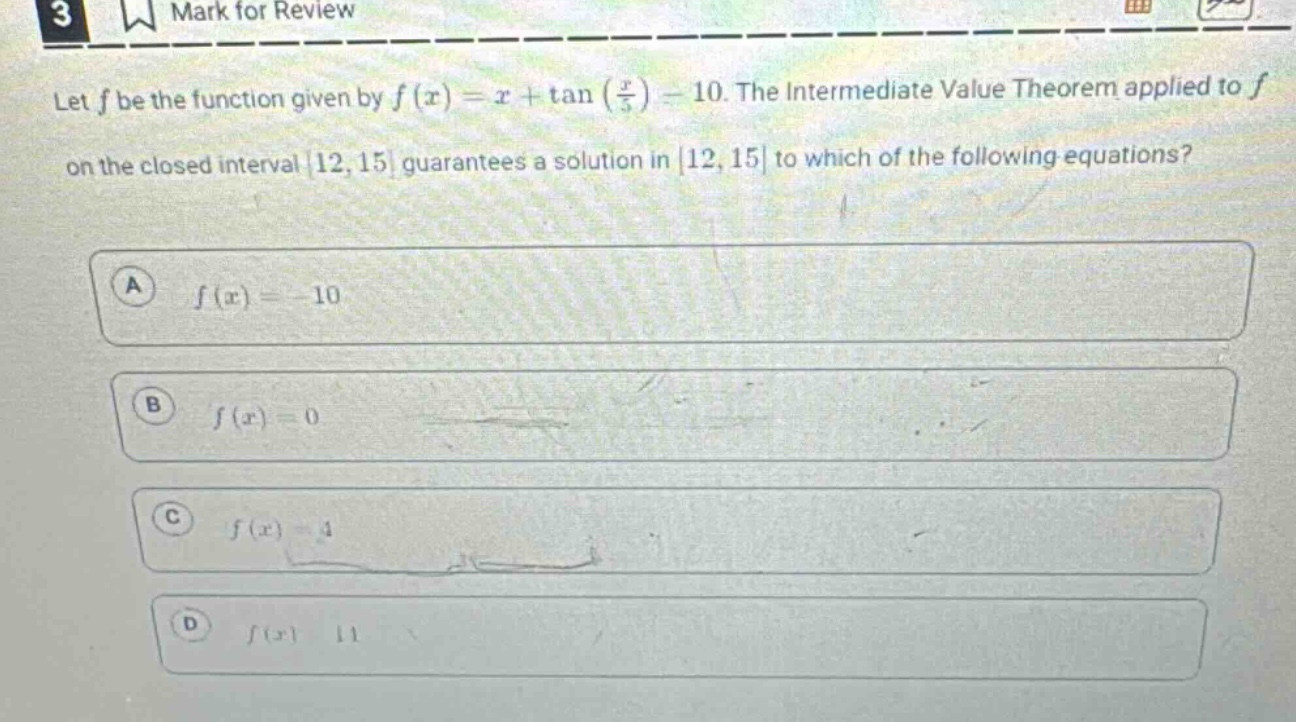
let f be the function given by f(x)=x + tan(x/5)-10. the intermediate value theorem applied to f on the closed interval 12,15 guarantees a solution in 12,15 to which of the following equations? a f(x)= - 10 b f(x)=0 c f(x)=4 d f(x)=11
Answer
Explanation:
Step1: Recall Intermediate - Value Theorem
The Intermediate - Value Theorem states that if a function (y = f(x)) is continuous on a closed interval ([a,b]), and (k) is a number between (f(a)) and (f(b)), then there exists at least one number (c) in the interval ([a,b]) such that (f(c)=k). We first find (f(12)) and (f(15)).
Step2: Calculate (f(12))
[ \begin{align*} f(12)&=12+\tan\left(\frac{12}{5}\right)- 10\ &=2+\tan(2.4) \end{align*} ] Since (\tan(2.4)\approx - 3.49), then (f(12)=2 - 3.49=-1.49).
Step3: Calculate (f(15))
[ \begin{align*} f(15)&=15+\tan\left(\frac{15}{5}\right)-10\ &=5+\tan(3) \end{align*} ] Since (\tan(3)\approx0.1425), then (f(15)=5 + 0.1425 = 5.1425).
Step4: Check each option
- Option A: (f(x)=-10). Since (-10) is not between (f(12)\approx - 1.49) and (f(15)\approx5.1425), there is no guarantee.
- Option B: (f(x) = 0). Since (-1.49<0<5.1425), by the Intermediate - Value Theorem, there exists a (c\in[12,15]) such that (f(c) = 0).
- Option C: (f(x)=4). We need to check if (4) is between (f(12)) and (f(15)). Since (4) is between (-1.49) and (5.1425), but we are looking for the most straightforward application. The Intermediate - Value Theorem is often used to find roots ((f(x)=0)) first.
- Option D: (f(x)=11). Since (11>5.1425), there is no guarantee.
Answer:
B. (f(x)=0)