let f be the function graphed below. if three subintervals of equal length are used, draw trapezoids whose…
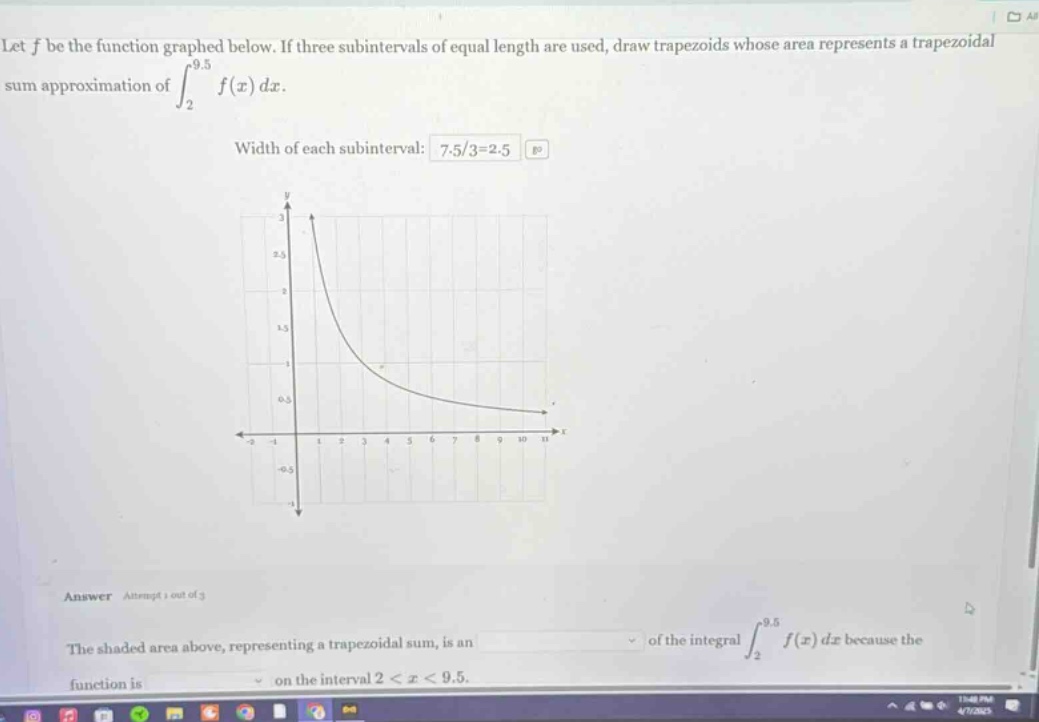
let f be the function graphed below. if three subintervals of equal length are used, draw trapezoids whose area represents a trapezoidal sum approximation of ∫₂⁹.⁵ f(x) dx. width of each subinterval: 7.5/3 = 2.5 answer attempt 1 out of 3 the shaded area above, representing a trapezoidal sum, is an of the integral ∫₂⁹.⁵ f(x) dx because the function is on the interval 2 < x < 9.5.
Answer
Explanation:
Step1: Determine sub - interval endpoints
The interval is from $a = 2$ to $b=9.5$ and $n = 3$. The width of each sub - interval $\Delta x=\frac{b - a}{n}=\frac{9.5 - 2}{3}=2.5$. The endpoints are $x_0 = 2,x_1=2 + 2.5=4.5,x_2=4.5 + 2.5 = 7,x_3=7+2.5 = 9.5$.
Step2: Recall trapezoidal rule formula
The trapezoidal rule for $n$ sub - intervals is $T_n=\frac{\Delta x}{2}[f(x_0)+2f(x_1)+2f(x_2)+\cdots+2f(x_{n - 1})+f(x_n)]$. Here, $T_3=\frac{2.5}{2}[f(2)+2f(4.5)+2f(7)+f(9.5)]$.
Step3: Draw trapezoids
To draw the trapezoids:
- At $x = 2$, draw a vertical line from the $x$ - axis to the curve $y = f(x)$.
- At $x = 4.5$, draw a vertical line from the $x$ - axis to the curve $y = f(x)$. Connect the top - end points of these two vertical lines with a straight line segment. This forms the first trapezoid.
- Repeat the process for the sub - intervals $[4.5,7]$ and $[7,9.5]$.
The shaded area above, representing a trapezoidal sum, is an approximation of the integral $\int_{2}^{9.5}f(x)dx$ because the trapezoidal rule uses trapezoids to estimate the area under the curve. Since the function is concave - down on the interval $2<x<9.5$ (as the curve is bending downwards), the trapezoidal sum is an under - estimate of the integral.
Answer:
Trapezoids are drawn as described above. The trapezoidal sum is an under - estimate of the integral $\int_{2}^{9.5}f(x)dx$ because the function is concave - down on the interval $2 < x<9.5$.