let f be a function of x. the value of lim f(x) can be found using the squeeze theorem with the functions g…
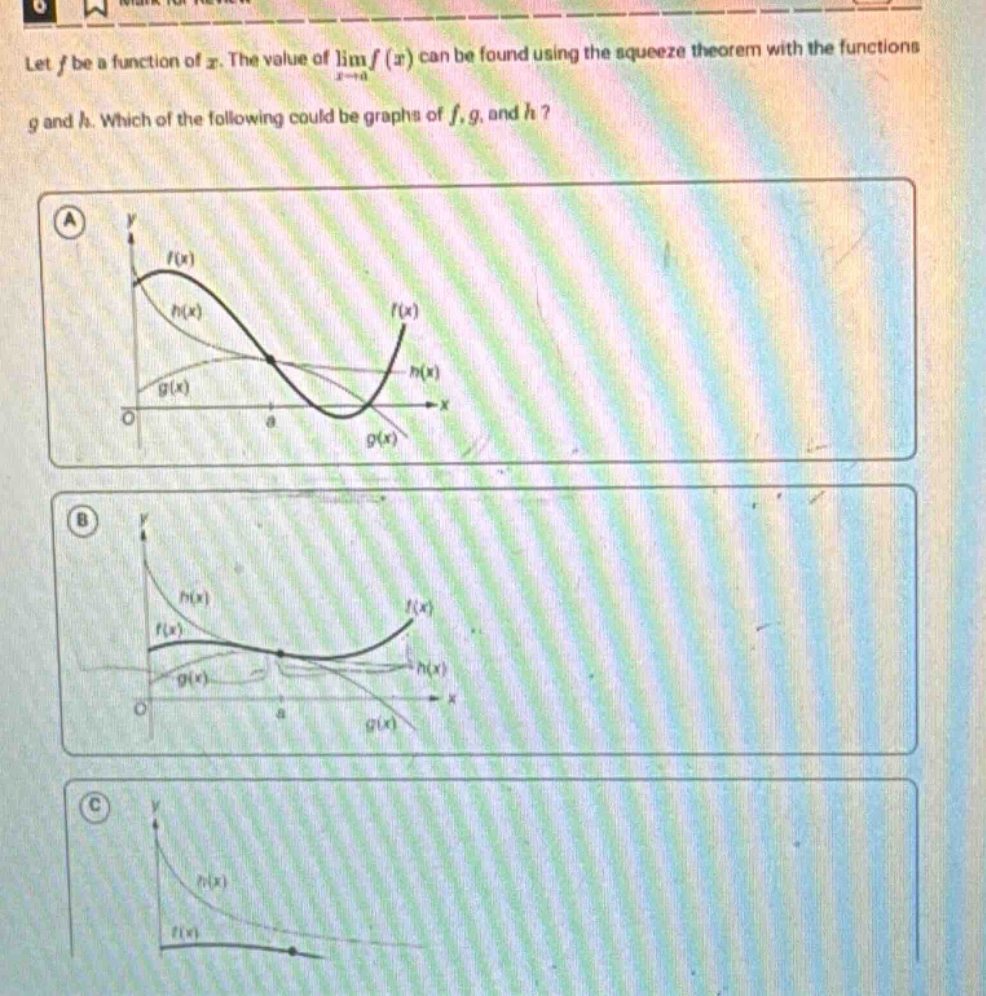
let f be a function of x. the value of lim f(x) can be found using the squeeze theorem with the functions g and h. which of the following could be graphs of f, g, and h?
Answer
Explanation:
Step1: Recall squeeze - theorem condition
The squeeze theorem states that if (g(x)\leq f(x)\leq h(x)) for all (x) in some open interval containing (a) (except possibly at (x = a)) and (\lim_{x\rightarrow a}g(x)=\lim_{x\rightarrow a}h(x)=L), then (\lim_{x\rightarrow a}f(x)=L). This means the graph of (y = f(x)) must be between the graphs of (y = g(x)) and (y=h(x)) near (x = a).
Step2: Analyze option A
In option A, near (x = a), there are points where (f(x)) is above (h(x)), so (g(x)\leq f(x)\leq h(x)) does not hold for all (x) near (x = a).
Step3: Analyze option B
In option B, for all (x) near (x = a), we have (g(x)\leq f(x)\leq h(x)), which satisfies the condition of the squeeze - theorem.
Step4: Analyze option C
In option C, there is no function (g(x)) shown, and we need three functions (f(x)), (g(x)) and (h(x)) for the squeeze - theorem, and also (f(x)) is not between two functions near (x=a).
Answer:
B